
Why beef cattle need good silage too

Making the most of forage in beef diets, and therefore reducing the requirement for home-produced or bought-in concentrates, not only gives protection from market volatility, it also reduces food miles and carbon footprint, through reducing fertiliser per kg of beef produced.
A recent study by Ireland’s Teagasc Agriculture & Food Development Authority monitored feed efficiency of forages of different digestibility (see Table 1).
BEEF CATTLE - TEAASC GRANGE | ||||
Digestibility (DMD%) | 75.00 | 70.00 | 65.00 | 60.00 |
Intake (kg/day) | 9.00 | 8.30 | 7.60 | 7.00 |
Liveweight gain (kg/day) | 0.83 | 0.66 | 0.49 | 0.31 |
Carcass gain (kg/day) | 0.51 | 0.39 | 0.27 | 0.15 |
Feed efficiency (DM intake/carc gain) | 17.60 | 21.30 | 28.10 | 46.70 |
*For the purpose of this article we are treating dry matter digestibility (DMD%), used in Ireland, as the same D-value, used in the UK New | ||||
To investigate the effects of different silage digestibilities in a real-life ration, Kelvin Cave have taken a typical beef finishing diet, using grass silage and other home-grown feeds, as shown in Table 2.
FEED | Kg fed |
Grass silage | 9.75 |
Crimped wheat/barley | 8.80 |
Crimped peas/beans | 1.00 |
Mineral with Actisaf | 0.10 |
Limestone granules | 0.06 |
This diet supplies: ME 12Kj/kg DM; crude protein 14.44%; starch 38.08%; forage 34.46% | |

By running this ration through the Feedmaster beef rationing program, it is possible to see the effects of changing the D-value of silage on both DLWG and the cost of that gain. This is shown in Table 3, which indicates growth rates achieved from the best silage (D-value 75) are some seven percent higher than those achieved from the worst silage (D-value 60). However, in practice, the diets shown in the two right hand columns would not be fed as they oversupply energy. This suggests that the cost per kg gain could be further reduced through better balanced diets.
Actual 64.5 D-value (10.3 ME) | 60 D-value (9.6 ME) | 65 D-value (10.4 ME) | 70 D-value (11.2 ME) | 75 D-value (12.0 ME) | |
DLWG (kg) | 1.44 | 1.41 | 1.44 | 1.48 | 1.51 |
Cost/kg gain (p) | 128.96 | 132.93 | 128.42 | 124.17 | 120.17 |
A more realistic scenario may therefore be to reformulate the diets using the same ingredients, in proportions which maintain the same liveweight gain, while using different D-value forages. We have illustrated this in Table 4. This shows around 10% in feed costs being saved by using high over low D-value forage. This is achieved with a ration comprising almost 58% forage and from a total saving of 3.8kg of home-grown concentrates per head per day. The value of this saving is 12.45p per kg DLWG.
Actual 64.5 D-value (10.3 ME) | 60 D-value (9.6 ME) | 65 D-value (10.4 ME) | 70 D-value (11.2 ME) | 75 D-value (12.0 ME) | |
DLWG (kg) | 1.44 | 1.44 not achievable with the indredients available | 1.44 | 1.44 | 1.44 |
Cost/kg gain | 128.96 | 128.42 | 122.0 | 116.51 | |
Total crimped cereal inclusion to balance diet (kg) | 8.80 | 8.50 | 6.00 | 4.80 | |
Total crimped pea/bean inclusion to balance diet (kg) | 1.00 | 1.01 | 1.12 | 1.20 | |
% forage in diet (kg fed) | 34.46 (9.75) | 36.29 (10.25) | 51.65 (14.60) | 57.93 (15.00) |
In reality, benefits are likely to be greater than this as a higher D-value silage is likely to also have more protein and sugar and so would perform even better in the diet. However, even taking this conservative, theoretical figure, a farmer with 200 head of cattle in a finishing unit would save over £5,080 using 70 D-value silage and over £13,087 per year using a 75 D-value silage, when compared with a 64.5 D-value silage.
Furthermore, there should be no significant additional costs involved in making high D-value silage as its production could be achieved simply by cutting earlier.
Investing in Safesil and, if necessary, making some changes to clamp management to reduce DM loss in fermentation and at feedout, and improve nutritional quality of the silage will likely bring further improvements.
Similar improvements in profitability can also be seen when feeding better quality silage using bought-in energy and protein blends as explained by independent beef nutritionist Lizz Clarke of LC Beef Nutrition on page 26.
Request a call back
You may also be interested in

Wholecrop boost for milk from forage
Producing milk from forage is a key target for every dairy producer, and wholecrop cereals can play a significant role in this ambition. Starch levels potentially approaching 30% and high levels of structural fibre to aid rumen function both contribute to good animal performance from this relatively easy-to-grow forage.
Learn more
21st century silage feeds Jurassic beef
Eric and James Sealey could never be accused of failing to grasp opportunities as they arise. Quick to see trends on the horizon and fast to respond, the father and son team have built a business which began life with meat sales from the back of a van; grew its turnover to £2.3 million by mid-2022; and will reach £2.5 million and rising by the end of this year.
Learn moreWhy beef cattle need good silage too
Making the most of forage in beef diets, and therefore reducing the requirement for home-produced or bought-in concentrates, not only gives protection from market volatility, it also reduces food miles and carbon footprint, through reducing fertiliser per kg of beef produced.
Learn moreRequest a call back
Related Products
SilageSafe
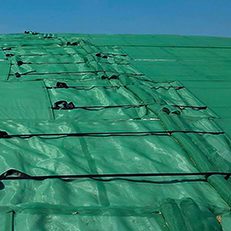
- Integrated tensioning straps
- Eliminates tyres and gravel bags
- Customised to clamp size
SilaPactor: Silage Compactor

- Increase DM density by up to 40%
- Up to 6 tonnes
- Speeds up silage compaction almost four-fold

News
Moisture meters for grain and hay
Moisture meters take the guesswork out of grain and hay preservation.
Learn moreStacking haylage in your favour
Pressure to reduce the use of plastic on bales comes from many directions, with wrap costs climbing, disposal often difficult and expensive, and plastic in fields and hedgerows unsightly and potentially damaging to livestock and wildlife. Its use may even incur a tax in future.
Learn moreBespoke KC frame allows quick switch from silage to grain
The Kelvin Cave workshop manufactures, modifies and refurbishes a range of milling and ancillary equipment, often making bespoke adaptations for specific farm requirements. One farmer in Warwickshire requested a quick-release IBC frame and Silaspray which can be used to apply additive to silage and easily switched to treating grain.
Learn moreA new feed on the block
A new bulk feed co-product could soon be available to UK farmers, thanks to innovative R&D by several companies, including Kelvin Cave, a British engineering company and an international waste, water and energy giant. The result will be a nutritionally dense, moist livestock feed.
Learn more