
Wet Weather Recovery Ideas
We are (hopefully) coming out of one of the most prolonged wet periods that most of us have ever experienced and normal winter cereal sowings are down by 65% to 85% in many parts of the country. This will, almost certainly, result in strong winter wheat prices in the coming year as well as disruption to cropping rotations into 2021.


Pulses
With increasing pressure to reduce the use of imported, and potentially genetically modified (GM), protein sources, another option to consider could be beans. Independent agronomist Steve Harrison, who covers parts of South Gloucestershire, Somerset, Wiltshire and South Wales, and Simon Vaux, regional head (north) for Agrovista, both agree that spring-sown beans could be useful for many growers this year.
“Their seeds are large and vigorous,” says Mr Vaux, “can germinate from deep in the ground, and although the best results come from drilling, the traditional method of broadcasting and ploughing in, could still be used.
“Drilling would normally be carried out from February to April, but growers would need to be sure they had an outlet for the crop,” he says. “They could either opt to harvest them as whole-crop silage or combine them to produce a high protein, concentrate feed.”
“Growers need to be sure that beans fit in around their existing crop rotation,” adds Mr Harrison, “but harvesting options such as whole-cropping, crimping or rolling and treating with Propcorn NC bring the harvesting date forward far enough so that autumn drilling of winter wheat is perfectly feasible.”
As readers of KnowHow will know from previous issues, all three options for treating beans have been used successfully by many farmers.
Whole-cropping beans will produce a high-protein forage that can add structure to any ruminant ration. Harvested at 60-70% DM with a typical crude protein level of 18-20%, whole-crop beans require an effective preservative, Safesil Pro, to ensure maximum feed retention and prevent the risk of losses and mycotoxins from mould growth. Close attention to achieving good compaction in the clamp and effective sealing is essential. Use of a SilaPactor for optimal compaction, and O2 Barrier 2in1 sheeting, protected by ClampNet and well weighted down with gravel bags or ClampTiles, to seal the clamp, will result in a palatable, rumen-friendly forage for dairy cows, growing and finishing cattle.
Alternatively, combining the beans provides the option of harvesting a range of moisture contents, to produce a high-protein/starch concentrate for older cattle. This ensures a good chance of clearing the crop between mid-September and early-October and drilling winter wheat, which will benefit from the nitrogen fixed by the previous crop.
Beans harvested with a moisture content of 30-50% can be crimped, treated with CrimpSafe 300 mixed with a moist feed such as brewers grains or draff, and ensiled. The added moist feed helps to ensure better compaction of the large, crimped beans, eliminating the risk of air pockets in the clamp. As with any ensiled feed, effective sealing and clamp management is essential to produce a first-class end product.

Typical analysis of crimped beans/brewers grains mix (on dry matter basis)
Crude protein (%) 26.85
Starch (%) 32.22
ME (MJ/kg DM) 12.80
Dry matter (%) 30-50%
If a dry, weather-proof grain store is available some growers may consider harvesting at a lower moisture content (below 25%) and storing aerobically using Propcorn NC, the modern, non-corrosive and low-fuming alternative to straight propionic acid. Suitable for treating whole or rolled cereals and pulses, this approach eliminates the need for expensive drying and produces a readily saleable product.
Request a call back
You may also be interested in

Ditching the plastic wrap
Kelvin Cave Ltd has been informed that plastic manufacturers are expecting significant price rises which are likely to affect the cost of bale wrap this season.
This highlights the benefits of treating moist hay and haylage with a preservative, which, at many moisture contents, can be used instead of plastic wrap.
Learn more
Close-up on Wholecrop harvesting and additives for preservation
Reserve forage stocks have been used up completely or severely depleted in many parts of the country and, for many, a wet autumn resulted in reduced acreages of winter cereals being sown. Then we had the late and difficult spring weather delaying drilling of crops even further. In order to get rotations back on track and replenish conserved forage reserves, turning cereal and even pulse crops into wholecrop silage could be a useful option to consider.
Learn more
Zero-tolerance of mouldy bales leads contractor to BaleSafe
Making hay and straw is an important part of contractor James MacDonald’s business, so he takes a zero-tolerance approach to mouldy or heated bales. As a result, BaleSafe has become a regular part of his armoury, which he uses at any point he feels moistures are too high or the weather is threatening.
Learn moreRelated products

Propcorn NC

- Safe, non-corrosive grain preservative
- For whole and processed grains and pulses
- Increases energy levels in feeds
News
Moisture meters for grain and hay
Moisture meters take the guesswork out of grain and hay preservation.
Learn moreStacking haylage in your favour
Pressure to reduce the use of plastic on bales comes from many directions, with wrap costs climbing, disposal often difficult and expensive, and plastic in fields and hedgerows unsightly and potentially damaging to livestock and wildlife. Its use may even incur a tax in future.
Learn moreBespoke KC frame allows quick switch from silage to grain
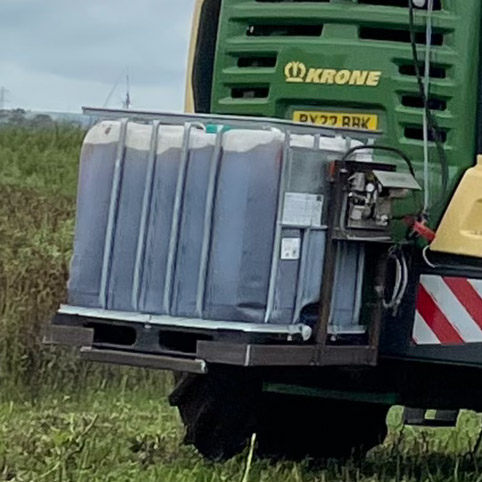
The Kelvin Cave workshop manufactures, modifies and refurbishes a range of milling and ancillary equipment, often making bespoke adaptations for specific farm requirements. One farmer in Warwickshire requested a quick-release IBC frame and Silaspray which can be used to apply additive to silage and easily switched to treating grain.
Learn moreA new feed on the block
A new bulk feed co-product could soon be available to UK farmers, thanks to innovative R&D by several companies, including Kelvin Cave, a British engineering company and an international waste, water and energy giant. The result will be a nutritionally dense, moist livestock feed.
Learn more