Wagyu Producer Raises Silage Quality with Safesil
Forage contractor and Wagyu beef producer, David Leighton (pictured), started using Safesil Challenge around two years ago and says he is now advising his customers to do the same.

Farming at Cloverley Hall Farm near Market Drayton in Shropshire, where he rears around 400 Wagyu beef to sell as stores and 200 Jersey x Holstein Friesian breeding bulls for sale to grazing-based dairy producers, he says any additive he used would have to prove its credentials in his eyes.
So, when he tried Safesil Challenge for the first time, he was keen to assess its performance for himself, and carried out a small trial on the farm.
“Before we made the commitment, we treated some bales of haylage and not others – all made from the same field – and you could tell just by looking that the treated bales were better,” he says.
“The cattle also preferred to eat the treated bales which are fed in ring feeders where they stay for up to three days. They ate them from the first to the last day, so there was no waste at all and the haylage stayed completely cold and certainly didn’t grow any mould.
“The additives we’ve tried in the past did not have the same effect, and the haylage would heat up in the feeder and some bales would be mouldy,” he says.
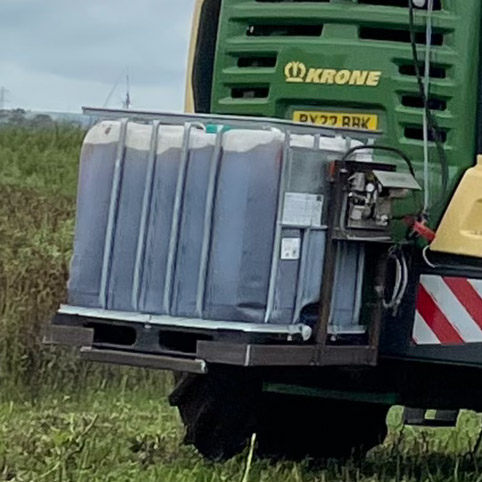
“We also like the fact that the Safesil Challenge comes in an IBC and is simple and ready to use. We much prefer this to mixing sachets with water, which doesn’t sit well with me.”
Aiming to make his baled haylage at a dry matter of 30-35% and his clamp silage at around 30%, he says DM sometimes drops below his ideal, to 25%.
“We prefer the 30-35% dry matter forage as it feeds so well,” he says. “This is particularly noticeable in the youngstock where you get no scouring with the drier product.”
With his Wagyu stores all ultimately destined for high-end outlets through Warrendale Wagyu, he has seen other improvements to health through better quality forage. In particular, he notes the lack of dust, which improves respiration and has cut out ‘silage eye’.
He says: “Now that we have confidence in using Safesil Challenge I’m recommending it to my contracting customers, as it just makes nicer silage.”
Andy Lee, Kelvin Cave’s manager across England’s central counties, explains why Safesil Challenge suits the farm so well.
“Safesil Challenge is designed to be used on either clamp silage of 30% DM or wetter, or baled silage of no more than 50% DM, where the risk of contamination by undesirable soil- and slurry-borne bacteria is higher,” he says. “These bacteria risk a poor fermentation and the associated losses of dry matter and nutritional value.
“Unlike other silage additives, Safesil Challenge contains ingredients which actually kill these bacteria while also promoting a fast and efficient fermentation.
“However, it will also inhibit the growth of yeasts and moulds which normally grow in the presence of oxygen, causing heating and spoilage,” he adds. “Used at the correct concentration, the human food grade preservatives contained in Safesil Challenge have been independently demonstrated to guarantee prolonged storage stability.” (Ref: Journal of Dairy Science, 94:824-831.)

Request a call back
You may also be interested in

Wagyu on grass silage-based ration boosts financial performance
First buying 87 head in 2022, he had to overcome preconceptions about the breed which he quickly discovered were misplaced.
A total mixed ration was compiled by independent nutritionist, Lizz Clarke, which comprises grass silage, waste potato chips, barley, Vitagold, with minerals and limestone flour.

21st century silage feeds Jurassic beef
Eric and James Sealey could never be accused of failing to grasp opportunities as they arise. Quick to see trends on the horizon and fast to respond, the father and son team have built a business which began life with meat sales from the back of a van; grew its turnover to £2.3 million by mid-2022; and will reach £2.5 million and rising by the end of this year.
Learn more
Arable farmer ditches combine in favour of forage
A Yorkshire farmer has turned a difficult situation following this summer’s drought to everyone’s advantage in a move which could be replicated across the country to help alleviate the forage crisis.
Learn more