
Robots and forage secure part-time farming future

Maximising the use of grazed grass and forage is a challenge in robotic milking systems. One Welsh dairy producer has done it so well, he can run his farm part-time and has transformed its long-term future.
It’s widely accepted that producing milk from forage – and in particular from grazed grass – is a challenge when milking through robots.
But on Adrian Windsor’s Fforest Farm near Whitland in Southwest Wales, the team has risen to that challenge. Here, the installation of two Lely Astronauts has seen grassland utilisation soar, preserved forage quality rise to new heights, and annual output per cow increase by a massive 40% over the course of 18 months.
Of this production, which now stands at 7,200 litres at 4.3% fat and 3.5% protein across 135 British Friesians, an impressive 4,020 litres per cow comes from grass and forage.
The fact that these accomplishments have been achieved while Adrian was in the process of simplifying his farming system, makes them all the more welcome. As a result, he doesn’t just farm his cattle and his grassland more efficiently than in the
past, but he has also been able to increase his availability as a retained firefighter, potentially working longer hours away from the farm every day.
The whole process began around six years ago when the installation of the robots kicked off a virtuous cycle.
“When we milked in the parlour, we’d spend over six hours milking every day and there was no time to move fences,” explains Adrian, who had always squeezed in his firefighting duties around his farming operation.
“But as soon as we had the robots, we were able to give the cows fresh grazing every 12 hours,” he says. “We introduced a free flow system which means they can come and go into the robot as they want, with the gate to their grazing changing every 12 hours.”

Allocating grazing
However, he says getting the grazing allocation exactly right has been a steep learning curve.
“With robots, you must have enough grass for the first and last cow,” he says. “Give them too much and they don’t come into the robot as often as they should; and give them too little, and they come in too often.”
Farming 240 acres (97ha) owned plus 150 acres (61ha) rented on a mainly grassland farm, he says the milking herd has access to around 200 acres (81ha) of grazing adjoining the dairy.
There is no buffer feeding throughout the summer, and ‘no time to put feed in a wagon’.
This means the summer ration comprises just grazing plus concentrates in the robot, with grass silage usually the only forage through the winter months.
“Last year we added maize to the rotation because of a grass shortage the previous summer,” he says.
And although it helped the farm out of a short-term forage shortfall, Adrian doubts he will grow the crop again, due to its growing costs and lower protein, which he has balanced by increasing the protein in the winter concentrate from 16% to 21%.
This means all the more importance is attached
to grass silage, which is the mainstay of the operation and is analysed every month to ensure the ration is carefully balanced.
However, over the years, its quality has posed challenges, and Adrian recalls: “I was never really happy because of the waste on top and the overheating.”
With only one huge clamp which accommodated every cut and all the farm’s forages, he was anxious to find a more consistently reliable way of retaining feed value and avoiding losses across a wide feed face.
Activator+CA
“We’ve tried additives from loads of companies over the years, but have never found any we’ve been happy with,” he says
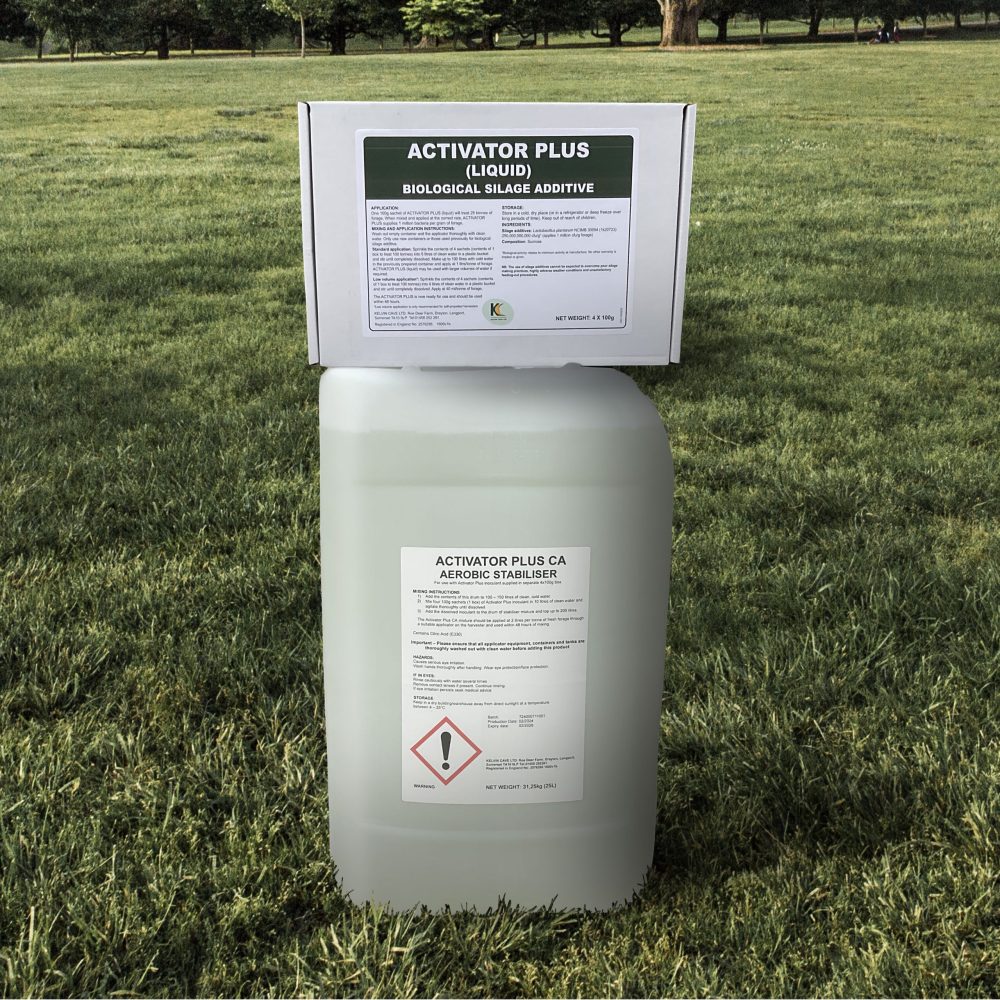
However, a conversation with Tim Frost, Kelvin Cave’s representative in South Wales and also a neighbour with whom Adrian keeps sheep on tack, led him to try Activator+CA, a silage additive which combines high concentrations of an elite strain of Lactobacillus plantarum with citric acid.
“It’s a unique combination which has been proven to achieve the rapid reduction in pH required for a stable lactic fermentation, good forage palatability and a high retention of nutrients,” says Tim.
“We first tried it around five years ago, and it lifted our grass silage ME [metabolisable energy] from 10.6 [MJ/kg DM] to 12,” says Adrian. “Since that year, ME has never dropped below 11.5 and the silage appears really stable, without any heat at all.”


Sticking with the product for both grass and maize, he says the wide face of the clamp and the addition of up to four cuts of grass and one crop of maize, have truly put the product to the test.
And although it’s proven to be equal to the challenge, he says there are still things he’d like to improve in his silage making.
“Everything is done by contractors which means we have to rely on when they can come, which isn’t always exactly when we’d like,” he says. “We’d like to cut every five or six weeks after first cut at the end of May and we’d like to wilt for longer to achieve a higher dry matter.”
However, he says he is much happier with the new system and with the time it has freed – not only for his own outside work but for that of his daughter Sally, who also combines working on the farm with being a firefighter, supplying boxed milk to seven local vending machines and TB testing on two days a week.
Whether part-time farming will become a future for the industry remains to be seen. But for Adrian and his family, a combination of improved grazing management, top quality forage and robotic milking have made it a success on Fforest Farm.
Forest Farm Facts
- 135 British Friesians and 350 Texel ewes plus lambs
- 390 acres (158ha) owned and rented including 200-acre (81ha) grazing platform
- Ewes and lambs graze 140 acres (57ha)of silage ground until 20 April
- First cut silage from 20 May onwards using solely contractors
- Up to four cuts with a target 5-6 weeks between cuts
- All silages including some maize now made with Activator+CA
- All forages clamped together for simplicity of winter feeding
- Milk from forage 4,020 litres/cow and just over one tonne of concentrates fed/cow/yr
- Sexed semen for dairy replacements plus British Blue semen and Limousin stock bull
- All male British Friesians and beef crosses reared and sold as stores at 14-18 months
- Robots, better forage and grazing management have lifted production by 2,000 litres/cow
- Milk sold to Dairy Partners’ plant in Newcastle Emlyn and through local vending machines
Request a call back
You may also be interested in

Cutting the cost of feeding for robot-milked Jerseys
Home-grown crimped concentrate feed and high-quality silage slash feed costs on Somerset farm.
Dairy farmer, Laurence Wadman, continually strives to make more milk from home-grown feeds on his family’s Somerset farm.
Learn more
GROWING the dairy ration has built PROFITS for REINVESTMENT
Cornish dairy producer, Tim Wood, is not one to follow the crowd. By growing his feed on the farm and improving the way it is processed, he has kept profits at home and fuelled reinvestment.
Learn more
Preserving Baled Forage Quality
Trying to outwit the unpredictable British climate is a constant challenge for forage producers.
At Kelvin Cave Ltd we’ve got a range of preservatives specifically formulated to treat all baled forages across the dry matter range, helping you to produce the best possible bales, whatever the weather throws at us!
Learn moreRelated products
Activator +

- Contains lactobacillus plantarum
- Supplies 1,000,000 bacteria per gram of forage
- Suitable for organic farmers
BaleSafe

- Hay, haylage & straw preservative
- For wrapped haylage 50-75% DM
- For hay up to 25% MC