
New research confirms some silage additives are no better than untreated control

New research carried out by an independent silage researcher has shown that silage additives containing heterofermentative bacteria produce maize silage which is no better than that conserved without any additive at all.
This work, undertaken by Silage Solutions, investigated five commercial additives and compared their performance on maize silage with one another and with an untreated control.
Outcomes were measured for a cross-section of parameters of which the most important were said to be dry matter (DM) loss and aerobic stability.
The silage additives trialled in this research were as follows:
- Magniva Platinum Maize (solely heterofermentative bacteria)
- Silosolve FC (a mixture of homo and hetero fermentative species)
- Bonsilage FitM (a mixture of homo and hetero fermentative species)
- Safesil Pro (a chemical salts-based preservative)
- Silasil Energy (homo and hetero, specifically aimed at the biogas industry)
Dry matter loss
The silage conserved with the worst of the additives lost over 9% of its DM, measured after 14 days, compared with about 4% loss for the untreated control (see graph 1). However, the best additive almost entirely prevented DM losses in the 14-day period, with these measured at under 0.4%.

The best performance came from the preservative-based product, Safesil Pro, from Kelvin Cave Ltd. The difference in DM loss between this and the average (mean) of the other four additives was 4%, saving four tonnes of silage DM for every 100 tonnes made with Safesil Pro.
Aerobic stability
An analysis of aerobic stability was also undertaken, which demonstrated no significant difference between four of the additives and the untreated control. However, Safesil Pro showed the only significant improvement, remaining stable for 50% longer than all other treatments and the control (see graph 2).

Additive composition
The key difference between the chemical additive and the others in the trial is in their different composition and mode of action. Safesil Pro is a salts-based product which comprises human food-grade preservatives, including sodium nitrite, sodium benzoate and potassium sorbate, which work by inhibiting undesirable bacteria, yeasts and moulds and allowing the natural lactic acid bacterial population to ferment the crop through the conversion of sugar into lactic acid.
However, the other four additives tested were all inoculants which included heterofermentative bacteria, either alone or in combination with homofermenters.
Dr Dave Davies from Silage Solutions, who carried out the research, explains: “The job of a silage additive is to rapidly drop the pH and inhibit the degradation of nutrients in the silo. They do this by inhibiting the activity of the plant enzymes and undesirable microflora.”
However, he says very few additives on the market have this ability, and he targets heterofermentative inoculants in particular for their unsuitable fermentation pathways.
He says: “When sugar is fermented in the silo, the only end-product that does not produce DM losses in the form of carbon dioxide and/or water is lactic acid.”

This is why additives should drive a fermentation which has lactic acid as the main end product.
However, he says inoculants containing hetero-fermentative bacteria have different fermentation pathways which produce other end products such as acetic acid, ethanol and propan1,2 diol (also known as propylene glycol).
These inoculants are sold to improve aerobic stability, but he says the process by which they do so creates products that are either not acidic or of weaker acidity. And byproducts of carbon dioxide and water are also produced, representing waste which is lost from the clamp.
This helps explain why the silage conserved with inoculants containing heterofermentative bacteria suffer dry matter losses.
Furthermore, he says the reactions by which these end products are created are too slow to achieve aerobic stability and to inhibit the growth of yeasts and moulds quickly to allow early opening.
This is also borne out by the research which showed all of the inoculant-treated silage was no more stable than the untreated forage.
Dr Davies says this latest research corroborates his long-held opinion that inoculants containing heterofermentative bacteria should never be used.
“My advice is never to use heterofermentative bacteria either alone or in combination with homofermentative inoculants,” he says.
“The aim should always be to promote a homofermentative fermentation [ie one producing only lactic acid], with the precise approach – homofermentative inoculant only, homo plus chemical or chemical only – dependent on your specific situation.”
Also commenting on the short duration of these results, with the ensiled forage opened after only 14 days, he says the analysis continued for up to 180 days – which is closer to the 200-plus days most silage is expected to be stored.
“Despite the improvement seen after 14 days my advice is to leave the silage sealed for as long as possible and preferably for at least one month,” he says. “But if you must open early, this research clearly shows the only additive worth spending money on is the chemical preservative.”
pH of the silage
The pH of the silage also gives an indication of the fermentation process (see graph 3).

He says: “The pH data again supports the fact that the heterofermentative inoculants, either alone or in combination with the homofermentative inoculants, do not improve the preservation process compared with no treatment.
“However, the chemical preservative in this study had a significant benefit on the preservation process across all ensiling time points.
“Taking all data together, the pH of the Safesil Pro treated silage was significantly lower [P<0.001] than all other treatments,” he said. “However, there were no significant differences between the remaining treatments and the untreated control.”
Asked why he believed companies continued to manufacture and sell heterofermentative-containing inoculants, he said: “They are ignoring the negative effects from heterofermenters and presumably they believe the aerobic stability is worth the losses in the clamp.”
Furthermore, this research confirms the heterofermentative inoculants do not give the aerobic stability after short ensiling periods that’s claimed.
Commenting on the mainstream farming media’s unwillingness to publish findings he said: “Getting research findings out to the farming community is increasingly frustrating and is a result of the farming press having significant financial support from the trade that don’t like the message.”

How the trial was conducted
Maize was collected from a commercial farm in Wales as it was harvested and processed through a forage harvester. The chopped maize was mixed well, subdivided into aliquots and subsequently treated with one of five different treatments (as detailed at the top of this article). There was also an untreated control. There were three replicates of each treatment. The maize was ensiled for periods of 14, 28, 60, 90, 120 and 180 days at which points it was measured for a range of parameters.
Aerobic stability was measured by taking a known amount of silage from every replicate, mixing well in air, loosely packing into an insulated cylinder and measuring the temperature every 15 minutes. Aerobic spoilage was measured as the time taken for the temperature to rise by 2oc above ambient.
DM losses were calculated by the difference between the fresh weight of forage ensiled and fresh weight of silage removed. Samples were oven dried to convert to dry matter and then represented as a percentage loss.
All parameters were measured according to strict, standardised UK and EU regulatory authorities’ methodology.
An investment of £2.66 per tonne of fresh weight treated withSafesil Pro returns an extra 28.93 litres of milk, worth £13.34.
The financial benefits
The team at Kelvin Cave Ltd are understandably delighted by the results of this trial which corroborates the company’s belief in Safesil silage preservatives. We are therefore giving the findings extensive coverage in this publication – something that’s unlikely to be seen elsewhere due to commercial interests or the mainstream farming media’s fear of jeopardising advertising revenue.
We have also taken the findings a step further by calculating their financial value.
The difference in DM losses between Safesil Pro and the inoculants tested (using their mean value) has been identified as 4%. So, for each 100 tonnes DM of maize silage preserved with Safesil Pro, only 96 tonnes would remain if preserved with a heterofermentative inoculant.
Lost energy
Assuming an average maize silage has a metabolisable energy of 11.5MJ/kg DM, this means that from each 100 tonnes made, the lost four tonnes equates to 46,000MJ of lost energy.
Lost milk
Since it takes 5.3MJ to produce 1 litre milk, this is valued as a £4,001 from the four tonnes lost from each 100 tonnes DM harvested, or from approximately 300 tonnes fresh weight (8,679 litres at 46.1p/litre).
The cost of treating this tonnage with Safesil Pro at a rate of 1.5 litres per tonne and a price of £1.77 per litre is £796.50.
On a per tonne basis, this means an investment of £2.66 per tonne of fresh weight treated with Safesil Pro returns an extra 28.93 litres of milk, worth £13.34.
Lost beef
The value for beef production is of a similar magnitude, with 36MJ required to produce each 1kg of liveweight gain. The lost 46,000MJ from 100 tonnes (DM) or from 300 tonnes fresh weight of Safesil Pro-treated silage is therefore worth £4,179.06 (1,278kg beef at £3.27/kg liveweight).
So, for every tonne of fresh weight treated with Safesil Pro, costing £2.66 per tonne, there’s a £13.93 return in extra beef.
All of this is in comparison with the four other additives tested, or with the untreated control.
Furthermore, it takes no account of the further benefits from Safesil Pro of the reduced heating at feed out if opening after 14 days of ensiling!
You may also be interested in

Making a proper job of silage in Devon
For Devon beef producer, Matt Widdicombe (pictured above), high quality silage is the lifeblood of his business. It’s made with strict adherence to good practice – two vehicles for compaction, good silage sheeting (both high grade side sheeting and oxygen impermeable dual top sheeting) and top-of the-range preservative, Safesil Pro.
Learn more
Wagyu Producer Raises Silage Quality with Safesil
Forage contractor and Wagyu beef producer, David Leighton (pictured), started using Safesil Challenge around two years ago and says he is now advising his customers to do the same.
Learn more
Breaking through the ceiling of low energy silage
Lifting silage quality from an ME of 10.5 to 12.5 MJ/kg DM has transformed both performance and morale on a South Wales dairy farm. The icing on the cake has been winning prizes too.
Learn more
MultiMax
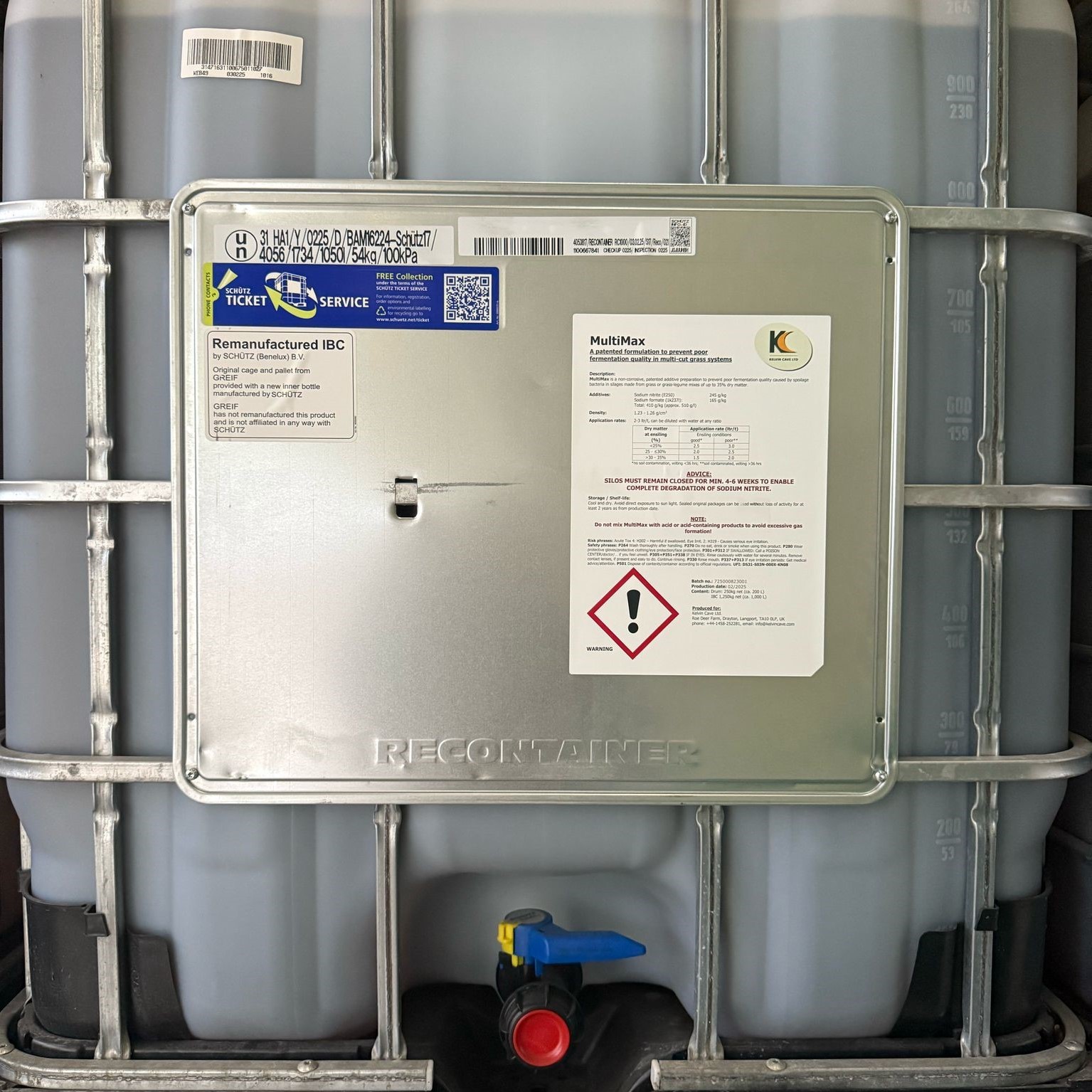
- For multi-cut grass systems
- Suitable for grass and legume silages up to 35% moisture
- Formulated to eliminate spoilage bacteria
SilaPactor: Silage Compactor

- Increase DM density by up to 40%
- Up to 6 tonnes
- Speeds up silage compaction almost four-fold