
MultiMax in multi-cut grass systems

Dr Horst Auerbach (pictured) from International Silage Consultancy, Germany gives some background to the development and testing of the new Kelvin Cave silage preservative, MultiMax, and explains how to ensure consistently good fermentation quality in silages from intensively managed grass leys.
Silage quality in general plays an important role in improving productivity and efficiency of dairy, beef and sheep production systems. However, silage making from forages, including grasses, legumes and mixtures thereof can be quite challenging due to rapidly changing weather conditions, especially during the phase when the forages have reached their optimal stage of maturity regarding nutrient and energy concentration. Delaying the harvest and increasing the wilting time ultimately results in losses, which cannot be compensated for by any means. More and more farmers have introduced a multi-cut grass system in which the forage is harvested at set intervals, such as every four weeks. Under these conditions, delaying one or several harvests during the season due to adverse weather and wilting conditions may result in one or even more cuts being missed, thereby reducing land productivity. Therefore, adhering to the planned cutting schedule forms the basis for the successful production of high-quality silage, largely irrespective of the prevailing weather and wilting conditions. Furthermore, the intensive use of organic fertiliser such as slurry or anaerobic digestate in multi-cut grass systems, which harbour clostridia spores, may lead to a higher risk of clostridia contamination of the forage to be ensiled.

Most potent clostridial inhibitor
In terms of weather dependency, the conditions in the UK’s multi-cut grass systems closely resemble those on large dairy farms in continental Europe, where hundreds of hectares of forages need to be harvested in each cut. Against this background, chemical silage additives based on sodium nitrite, which is the most potent clostridial inhibitor, have been successfully and widely used for more than 40 years, and its use continues to increase. In the past, sodium nitrite was used together with hexamine. Nitrite exerts its effect during the initial stages of fermentation by directly killing undesirable spoilage bacteria such as clostridia, and is subsequently decomposed to nitrous gases and/or ammonia. Hexamine was used to protect silages from poor fermentation quality during the later stages of extended storage periods by inhibiting clostridia, which may have survived the initial attack by nitrite. However, recent research has demonstrated that hexamine can be fully replaced by sodium formate, a salt of formic acid (Auerbach et al, 2023). Data from a series of trials with a range of temperate forages with largely varying dry matter (DM) content at ensiling clearly demonstrated the consistent benefits of using a nitrite/formate-based additive – MultiMax – in terms of reducing DM losses during fermentation and improving fermentation quality.
In another grass trial, which was not included in the aforementioned dataset, MultiMax showed its great potential to safeguard good fermentation quality even under very challenging conditions of low DM content (22%) in combination with high ash concentration (18% of DM), which was the result of the addition of 50g of soil per kg forage before silage additive application. At both application rates, MultiMax successfully suppressed clostridial activity, as evidenced by the absence of butyric acid, much lower ammonia-N, higher lactic acid and lower ethanol concentrations, thereby significantly improving the efficiency of the fermentation process by reducing DM losses, compared with an untreated control.
Trait | Untreated | MultiMax |
Dry matter % | 27.0 | 27.7 |
Dry matter loss % | 8.0 | 5.8 |
pH | 4.74 | 4.42 |
NH3-N (%of total-N) | 18.3 | 12.8 |
Lactic acid (%DM) | 5.92 | 7.43 |
Acetic acid (% DM) | 2.52 | 2.50 |
Butyric acid (%DM) | 1.88 | 0.00 |
Ethanol (%DM) | 0.95 | 0.43 |
Water-soluble carbohydrates (%DM) | 1.13 | 3.75 |
Aerobic stability (hours) | 196 | 207 |
Table 1: Effects of a chemical additive composed of sodium nitrite and sodium formate (MultiMax) on silage
quality (Auerbach et al, 2023)
It is worthwhile to mention that MultiMax, when used at the recommended application rates (1.5 – 3.0 litres/tonne, depending on DM and ensiling conditions), will not impair the activity of the natural lactic acid bacteria, which are present on the forages so that a natural lactic acid fermentation process takes place in the silo. The product has been shown to only selectively inhibit undesirable spoilage bacteria.
In summary, Multimax’s highly effective, patented formulation, composed of sodium nitrite and sodium formate, is a strategic tool for producing high-quality grass silage under challenging conditions. It fits in well with the multi-cut grass system in which harvests need to be scheduled largely independent of the prevailing weather conditions to maximise yield and quality.
List of references on request.

MultiMax facts
- Preserves relatively low DM forages (up to 35%)
- Ideal for multi-cut systems especially in adverse conditions
- Formulated to cope with soil and undesirable bacterial contamination
- For use where aerobic stability is not the challenge
- Neutral salt-based additive
- Not corrosive on skin, eyes and metal
- Odourless
- Does not increase effluent production (as do formic acid-based products)
You may also be interested in

Back to basics on silage preservation and protection
Good practices in preservation and compaction are key to making great silage and minimising fermentation losses during storage and aerobic losses during feed out.
Learn more
Evolution, not revolution, in crimped grain preservatives
Many of the things we take for granted in our modern lives have evolved over time.
The wheel, for instance, has been around for millennia. But transforming it from a roughly hewn disc of stone or wood into a high-performance lightweight alloy rim has been an evolutionary process – the product of initiative, innovation and a desire to make something that performs better than its predecessor.
The same has been true when it comes to crimped grain preservation.
Learn more
Six tips for silage survival in a changing climate
The changing climate demands adaptations to our silage-making practices. Silage specialist, Dr Dave Davies of Silage Solutions Ltd, provides his tips for silage survival, and says above all, be flexible.
Learn moreMultiMax
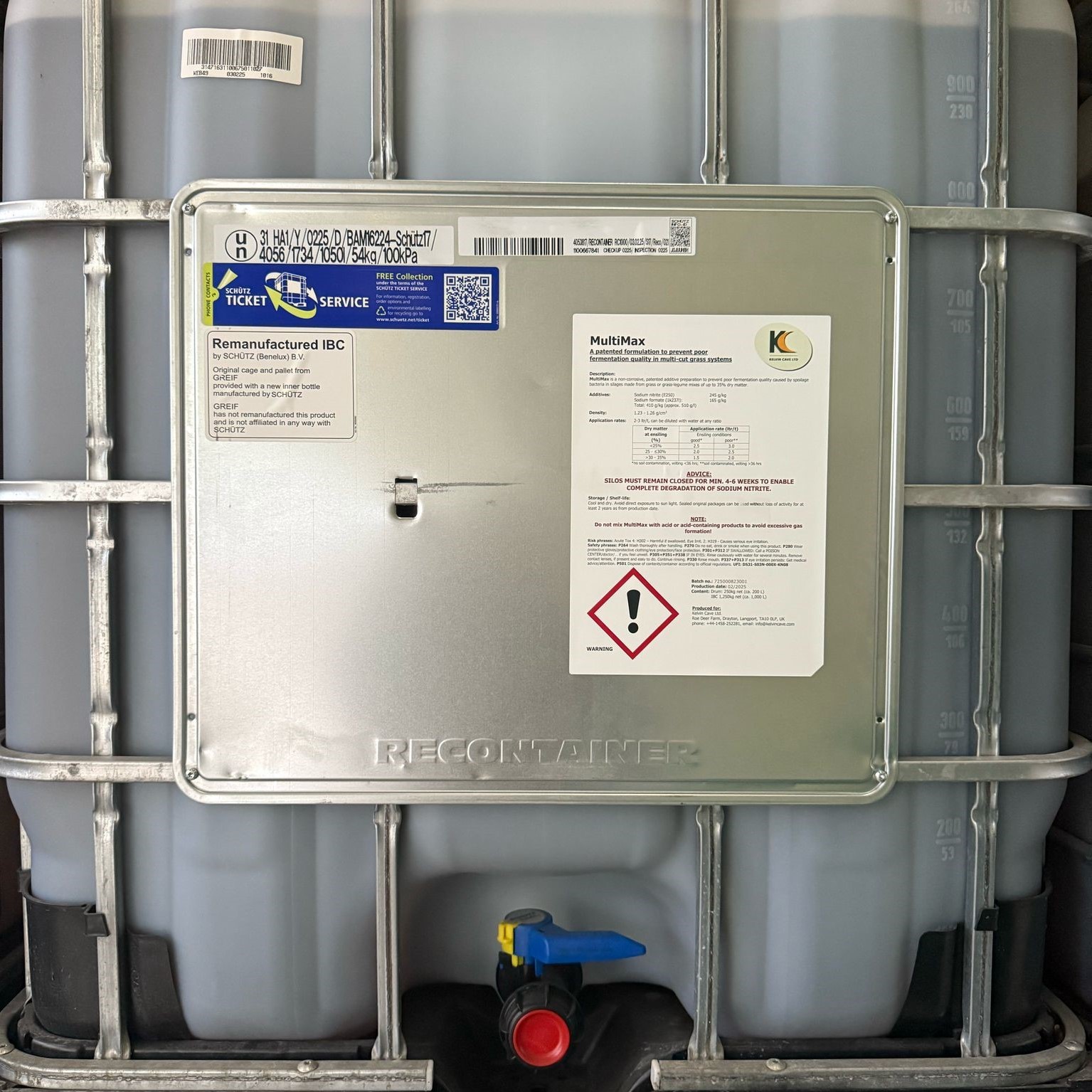
- For multi-cut grass systems
- Suitable for grass and legume silages up to 35% moisture
- Formulated to eliminate spoilage bacteria
BaleSafe

- Hay, haylage & straw preservative
- For wrapped haylage 50-75% DM
- For hay up to 25% MC