
Bespoke KC frame allows quick switch from silage to grain
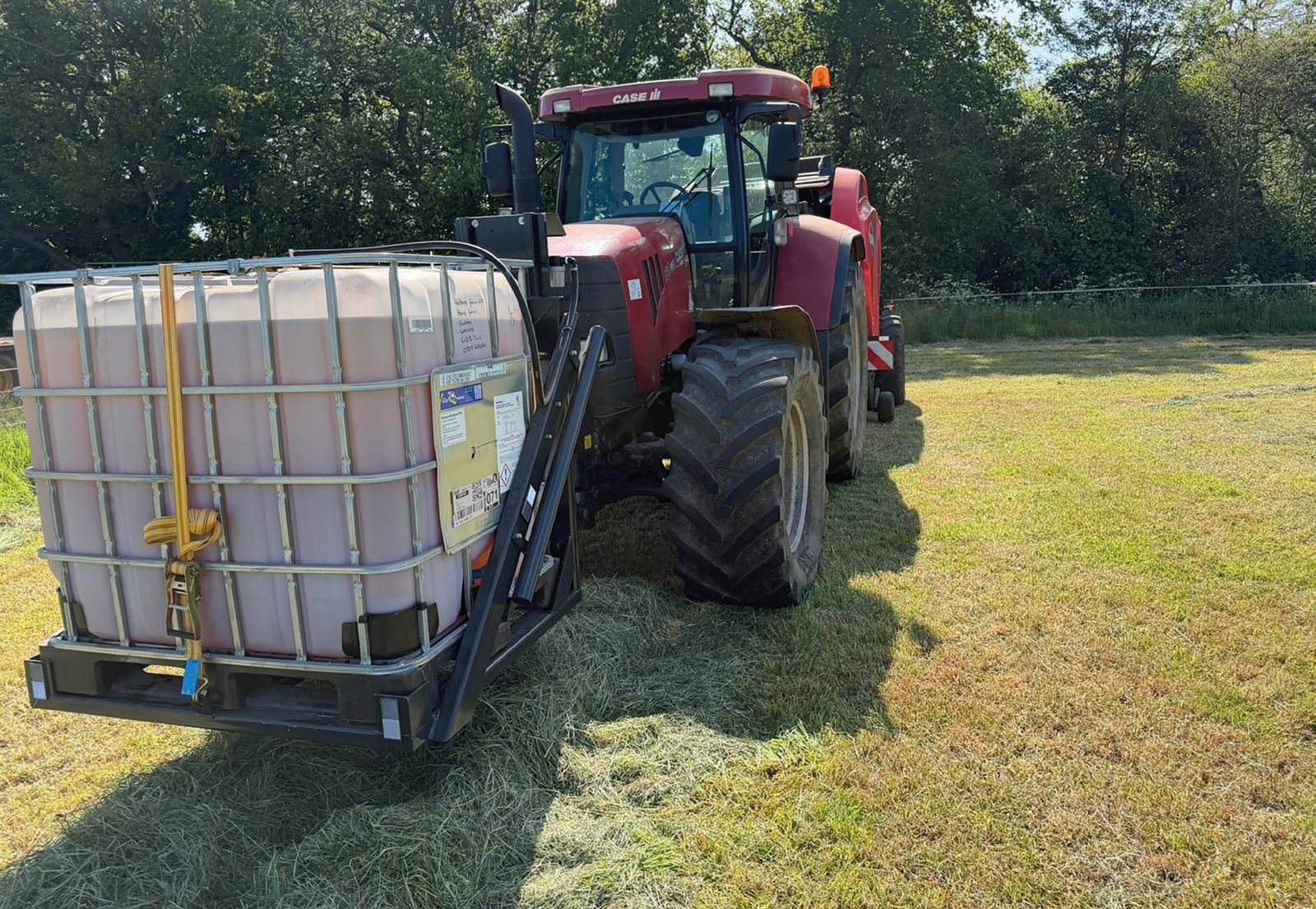
The Kelvin Cave workshop manufactures, modifies and refurbishes a range of milling and ancillary equipment, often making bespoke adaptations for specific farm requirements. One farmer in Warwickshire requested a quick-release IBC frame and Silaspray which can be used to apply additive to silage and easily switched to treating grain.
Flexibility is at the heart of operations at Hatton Farms in Warwickshire, where manager Frans Hamman says the business will switch emphasis from one enterprise to another as markets dictate.
This attitude has fed through to the farm’s investment in a bespoke, front-mounted IBC carrier with a built-in Silaspray, which can be used to apply additive to forage just as easily as it can be switched to applying it to grain.
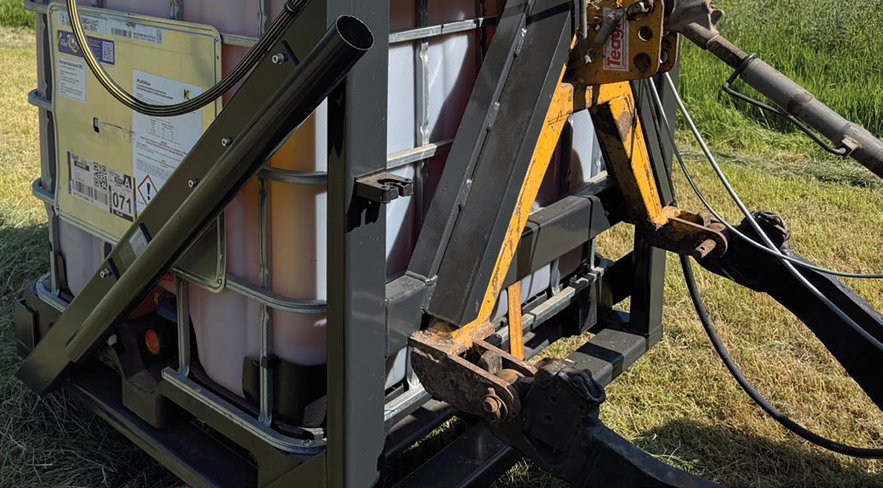
A single Silaspray applicator is built into the frame and sits alongside an IBC containing the relevant additive. Mounted into an A-frame with quick-release couplings, it can be easily attached to the front linkage of a tractor at silage-making time.
With permanent pipes running under the tractor to nozzles on the baler, this year Frans is using it to apply the silage preservative, MultiMax. After silage is complete, he can quickly release the frame from the tractor and uncouple it from the pipes, ready to rejoin the kit to the roller mill in the yard. Easily attached to the farm’s Murska 350, the Silaspray feeds another set of nozzles on the mill which applies a preservative to the grain.

Commenting on dealing with the Kelvin Cave team who designed the equipment, Frans says: “They built it in their workshop and we fitted it to the machinery on the farm. We found the team to be extremely helpful and always available at the end of the phone.
We were impressed with the build quality and finish of what is essentially a plug-and-play solution. We keep a set of nozzles permanently on the baler and another on the mill, and we just fix the tank and Silaspray with couplers as and when required.”
Propcorn NC
Last year’s stored barley is now being treated with Propcorn NC at the same time as rolling, in order to use it as a livestock feed. This gives it additional keeping quality after rolling and enhances its nutritional quality, allowing batches of 10-15 tonnes to be milled at a time. Completed at an estimated rate of around six tonnes an hour, the task is quick and easy to carry out at a convenient time by the farm’s own staff around once a month.
The treated grain will be fed to around 100 head of finishing cattle on the farm at any time, which are just a small part of the 2,500-acre (1,012ha) operation.
Harvest 2026
For this year’s cereal harvest Frans says he will cut headlands early at a higher moisture content (between 18% and 25%) and will roll the grain and treat it with Propcorn NC on the day of harvest. This will allow the rolled corn to be stored for 12 months for feeding to cattle, which are fed ad lib baled silage and ad lib rolled barley.
Agronomic benefits are also expected from the earlier harvest, which Frans hopes will assist with weed control – notably blackgrass and rye grass – which should shed less seed. Enlarging the window for autumn cultivations is a further benefit of the earlier harvest on the predominantly arable farm.
Frans says the farm will continue with the cattle for as long as it stacks up financially, but every enterprise is regularly costed to ensure it is viable. “We always try to be agile as a business and will only keep an enterprise when the costs stack up, so will stop buying store cattle if the prices aren’t right.” Commenting that there has been a pause in cattle buying in the present market, he says this will only resume when the margins stack up.
“We can always sell baled silage if we stop keeping beef but want to ensure its keeping quality is good. We chose MultiMax as we have read the science and feel confident it will give us well-preserved bales. We have had experience of bales being wasted in the past, so we hope this year’s will last for at least 12 months, giving us high quality bales for our own cattle or to sell as the markets dictate.”
Hatton Farm facts
- 2,500 acres (1,012ha) of cereals plus 100 acres (41ha) of grass in Warwickshire.
- Buy in stores, favouring British Blues at 200-500kg.
- Sell finished beef mostly through the Foyle Food Group at around 600-700kg.
- Cattle all fed ad lib baled silage and ad lib Propcorn NC-treated barley.
- 430 bales of first cut silage made from 70 acres (28ha); second cut to follow.
- Grassland comprises permanent pasture and new herbal leys.
- MultiMax chosen as silage additive for lower dry matter (approx 30-35%) silage.
- Commissioned bespoke front-mounted IBC carrier and Silaspray from Kelvin Cave.
- Similar equipment could be used for silaging with baler, forage wagon or trailed forager.
- Bespoke Kelvin Cave equipment doubles up for treating grain with additive through the mill.
You may also be interested in

MultiMax…the New Silage Additive
MultiMax, the preservative-based additive has been formulated to wipe out spoilage bacteria which can be prevalent in silage harvested in the tight weather windows which are often a feature of multi-cut grass.
Learn more
MultiMax in multi-cut grass systems
Dr Horst Auerbach from International Silage Consultancy, Germany gives some background to the development and testing of the new Kelvin Cave silage preservative, MultiMax, and explains how to ensure consistently good fermentation quality in silages from intensively managed grass leys.
Learn more
Gearing up your grassland for silage
Much can be done to grassland to improve the chances of a good outcome when it comes to making silage. Dr George Fisher, grassland consultant, advises on steps to be taken in the run-up to the event.
Learn moreMultiMax
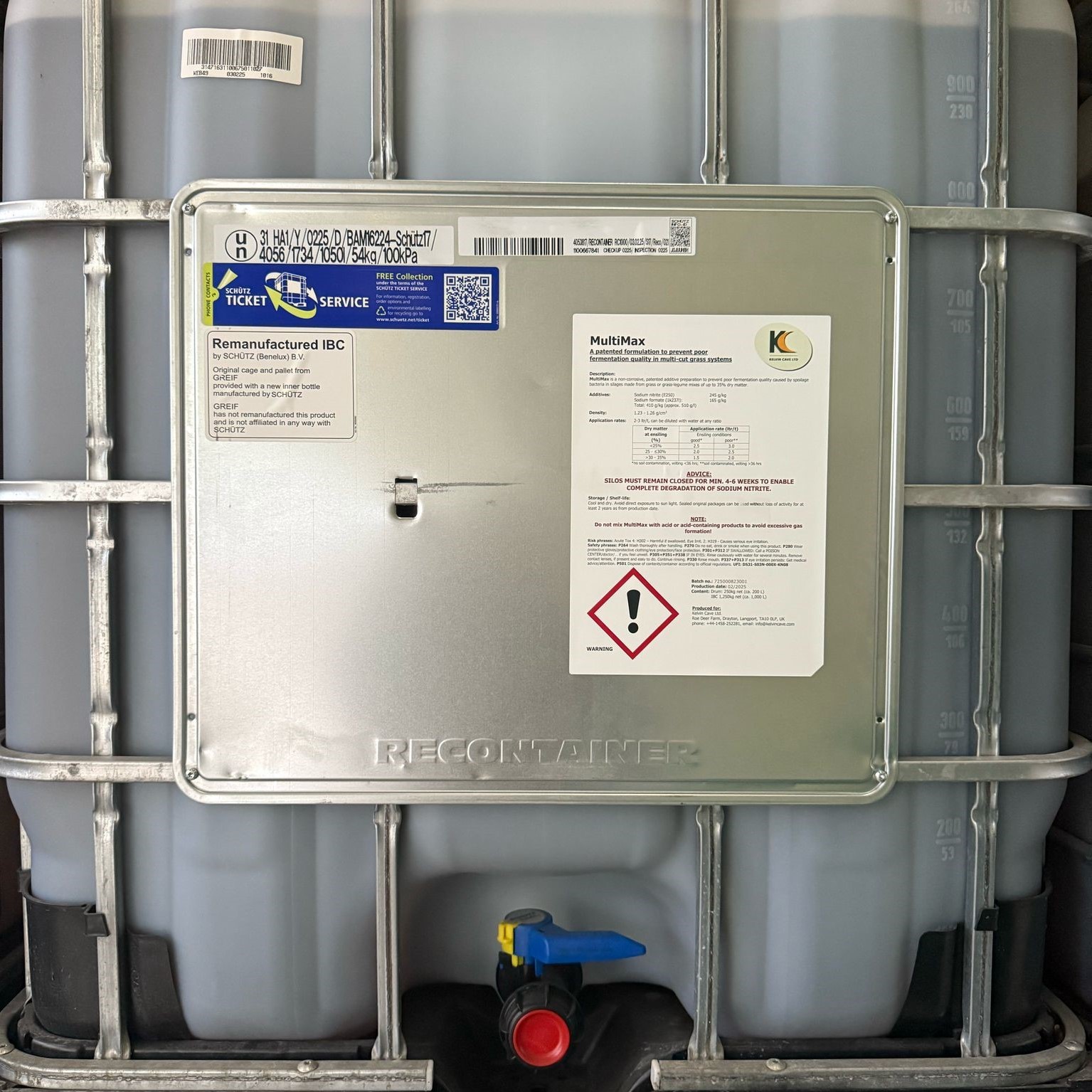
- For multi-cut grass systems
- Suitable for grass and legume silages up to 35% moisture
- Formulated to eliminate spoilage bacteria
Silaspray SP Compact
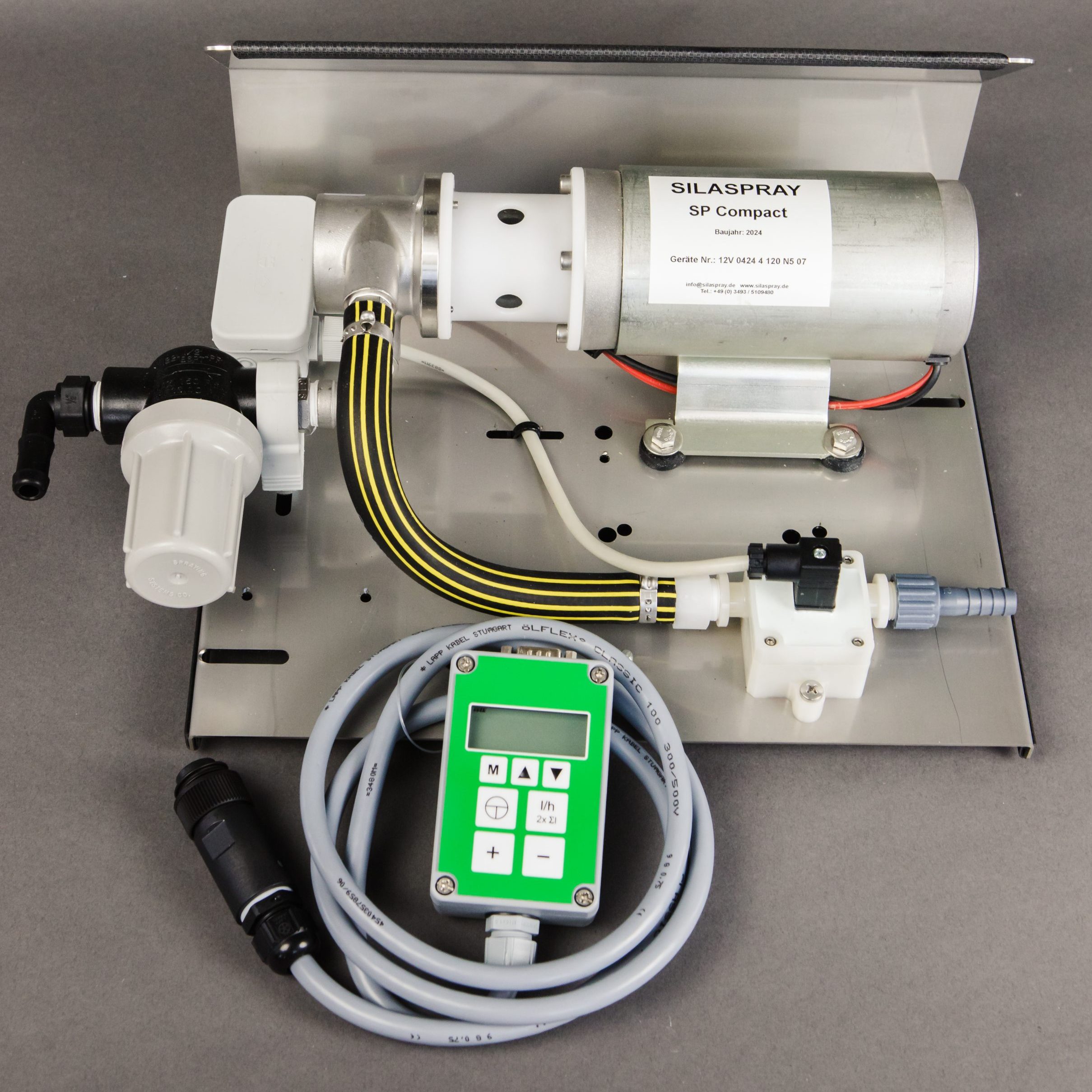
- Applies all acids, salt based preservatives and biological inoculants
- Pump output: 30-500 litres per hour
- Only available from Kelvin Cave Ltd in the UK
ProFlake NC

- Dry grain conditioner and preservative
- Improves physical quality and reduces dust
- Improves feed value and storage life
