
When conditions are tough chemical preservatives get going

Last autumn, Kelvin Cave brought MultiMax to the market, at a time when silages were being made in challenging conditions. This additive – based on sodium nitrite and sodium formate – prevents clostridial fermentations in low dry matter, potentially soil-contaminated, grass silage. In this issue of KnowHow, Dr Horst Auerbach (pictured right) from Germany’s International Silage Consultancy (ISC), explains the MultiMax mode of action and how it should be safely used.

Mode of action and fate in the silage
Sodium nitrite-based silage additives have been widely used in Europe for decades. But their use has attracted particular attention recently as empirical evidence from farms has shown that silage inoculants (additives based on lactic acid bacteria), regardless of their composition, cannot safeguard a proper fermentation process under challenging conditions.
During the early stages of the fermentation process, sodium nitrite (NaNO2), which is used as a food preservative in cured ham and bacon and salami, actively and selectively kills clostridia (and their spores coming from the soil). Thereafter, the substance is degraded into the gases nitrous/nitric oxide, and ammonia. Some of the gaseous compounds will leave the silo as yellowish-brown gas. This is a process which naturally occurs whenever the forage contains nitrate (NO3-) at the time of ensiling. During fermentation, nitrate is converted into nitrite, which follows the fate of added nitrite. So, one could even consider nitrite a natural chemical silage additive.
As nitrite is and must be degraded during fermentation, a second substance must be used that is not degraded and remains in the silage to make sure any clostridia that may have escaped the attack by nitrite can not germinate and grow. The patented formulation of MultiMax therefore includes the very well-known compound sodium formate (a salt of formic acid).
There is a large body of evidence in scientific literature which shows that nitrite degradation is rapid and complete (Table 1). However, it is recommended to leave the silo closed for at least four, better six weeks. This period includes a safety margin to account for all possible variation.
Table 1: Fate of nitrite (NO2-) during the fermentation process
Fermentation length (days after ensiling) | Nitrite (NO2-) (g/t fresh matter) | |
Early-cut rye (27% DM) | Grass (40% DM) | |
At ensiling* | 600 | 600 |
3 | 235.5 | 7.5 |
14 | 1.2 | 0.7 |
28 | 0.8 | 0.6 |
42 | 0.7 | 0.3 |
90 | 1.0 | 1.1 |
*Equivalent of 900g sodium nitrite/kg fresh matter applied, equivalent to an application rate of 2.8l/t MultiMax
Trials in Germany demonstrated:
- MultiMax is safe and non-corrosive
- MultiMax sustainably suppresses clostridia development in low DM/ high ash forages
- MultiMax outperforms inoculants under challenging conditions regardless of their composition and inoculation rate
Comparison between MultiMax and several commercial inoculants
There is a large body of data which demonstrates the efficacy of MultiMax in comparison with no additive used. However, as inoculants have become important silage additives across the world, not least because of lower costs and lower application volume to use, it is important to know how each additive type performs under challenging conditions. For that reason, a trial using grass (26% DM, 16% crude protein, 14% crude ash) was carried out at the University of Applied Sciences in Bernburg, Germany. The results in Figure 1 clearly show that MultiMax outperformed any of the different inoculant formulations. It was the only additive that could sustainably suppress clostridia development. None of the tested inoculants – regardless of the number of strains, the type of strain, the inoculation rate – ensured a normal, lactic acid-dominated fermentation process. In fact, concentrations of this acid were even lower in all the inoculant-treated silages than in the untreated control. With the exception of MultiMax-treated silages, all silages had high pH and ammonia concentrations and contained butyric acid at very high concentrations, whereas MultiMax could prevent clostridial activity completely. As a result, due to an efficient fermentation process, DM losses during fermentation were reduced by 32% when compared with untreated silage.
Figure 1: Effects of different additive types on the fermentation of low DM/high ash grass silage stored for 123 days

Request a call back
You may also be interested in

Back to basics on silage preservation and protection
Good practices in preservation and compaction are key to making great silage and minimising fermentation losses during storage and aerobic losses during feed out.
Learn more
MultiMax in multi-cut grass systems
Dr Horst Auerbach from International Silage Consultancy, Germany gives some background to the development and testing of the new Kelvin Cave silage preservative, MultiMax, and explains how to ensure consistently good fermentation quality in silages from intensively managed grass leys.
Learn more
Preserving Baled Forage Quality
Trying to outwit the unpredictable British climate is a constant challenge for forage producers.
At Kelvin Cave Ltd we’ve got a range of preservatives specifically formulated to treat all baled forages across the dry matter range, helping you to produce the best possible bales, whatever the weather throws at us!
Learn moreMultiMax
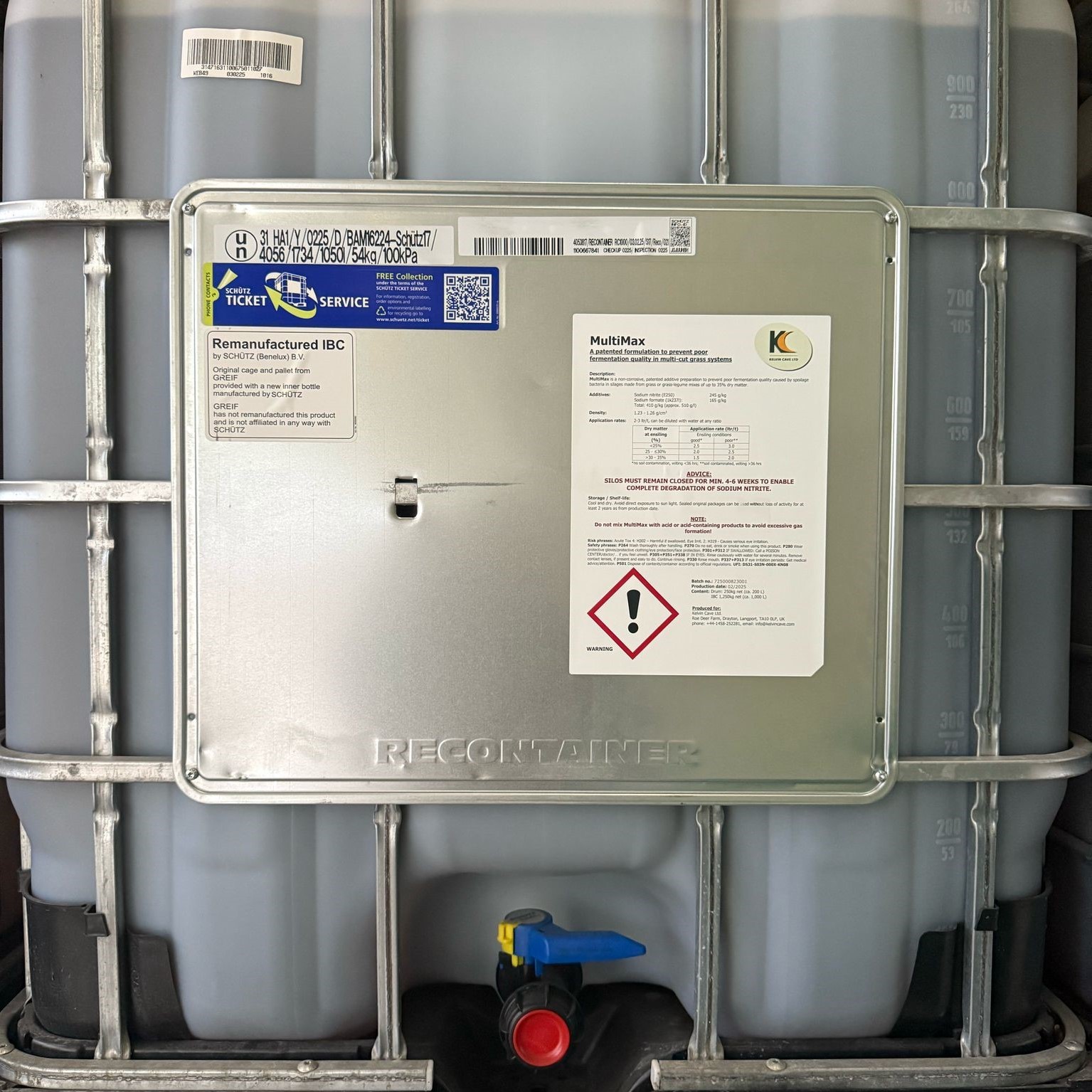
- For multi-cut grass systems
- Suitable for grass and legume silages up to 35% moisture
- Formulated to eliminate spoilage bacteria
SilageSafe
- Integrated tensioning straps
- Eliminates tyres and gravel bags
- Customised to clamp size
Safesil Challenge
- For lower DM grass silage
- Human food-grade preservative
- Suitable for clamps, bales and ag-bags