
Options for improving the protein content of grass silage

While the industry turns to legumes and pulses to bolster protein in livestock diets, independent consultant, Dr George Fisher, says grassland should not be overlooked as a source of greater protein.
With pressure on input costs and the supply chain gearing up to remove imported soya in diets, the content and quality of protein in home-grown forages is gaining importance. Previous issues of KnowHow have reported on the practical experience of customers growing beans and peas to increase protein produced on-farm. Indeed, Kelvin Cave Ltd is involved in the Innovate UK funded NCS Project, a nationwide project bringing together researchers and commercial partners to promote the growth of beans and peas for use in ruminant diets to replace soya bean meal and improve the industry’s carbon footprint. But what about looking at grass-based production itself and what we can do to improve the protein situation there?
There are ways of improving the protein content of our base grassland production. Some involve the use of clovers and others focus on the fertiliser programme. And we know that improving the quality of protein in grassland has positive impacts on milk and meat production by increasing the intake of forage and the efficiency of converting feed into product.
What is crude protein?
We all see the term crude protein on our forage analyses from the lab. It’s usually shown as CP% and we are told ‘the higher the better’. Generally, we are aiming for 15% in the base forage for milk production and 12% for meat. But what does the number mean?
Proteins are made up of amino acids and the main element in these is nitrogen, so the lab will measure the nitrogen content of your forage and multiply this by 6.25 to give an indication of the amount of protein that’s there. The factor of 6.25 is a way of simply converting from a nitrogen measurement to how much amino acid, or ‘true protein’ that this will represent.
However, not all nitrogen in your forage is present as ‘true protein’. Some will be there as nitrate, nitrite and ammonia – which is termed ‘non-protein nitrogen’. So, your CP% is an estimate derived from both true protein and non-protein nitrogen – that’s why the term used is ‘crude’ protein.
But it’s the true protein that increases intake and the efficiency of converting feed into product. So you can have a crude protein of 20% in your forage, but this might be made up of 10% true protein and 10% non-protein nitrogen. Or, it might contain 18% true protein and 2% non-protein nitrogen. The latter is better than the former!
What we want to aim at doing is increasing the proportion of our CP% as true protein and minimising the non-protein nitrogen part.
Fertiliser nitrogen inputs and CP%
It follows that the more nitrogen we apply to grass, the higher the CP% tends to be. This is clearly shown by an extensive study led by Rothamsted Research out of North Wyke in Devon. They took three or four silage cuts from perennial ryegrass swards at five sites over four years and the average results are shown in the graph below. We can see that increasing fertiliser nitrogen inputs increased CP%, but it was still difficult to get to the 15% target.

Using clovers
Clovers are known for having a higher digestibility than grasses, but they also have a greater content of true protein, so they can increase our CP%. Many grassland farmers are reducing application rates of manufactured nitrogen fertilisers due to increased costs, and this line of thinking opens up the possibility of using clovers, both as a source of ‘free nitrogen’ for grass growth, but also as a way of improving the content and quality of CP%.
Red clover
Although red clover is a bit of a ‘princess’ to grow (it doesn’t like being cut too low, crushed by wheels or very wet conditions), it is an excellent source of true protein. And the modern varieties are more persistent and so last longer in grass swards.
Table 1 shows the protein content of red clover grown alone and in combination with perennial ryegrass. All the numbers are above the target of 15% for dairy production.

Table 1:
White clover
Whilst red clover does not tolerate inputs of manufactured nitrogen fertiliser well, the modern varieties of white clover are more competitive against grass and can persist in swards, even with moderate inputs of nitrogen from the bag. If this is the approach taken in order to assure grass growth, then the white clover will not fix as much nitrogen from the atmosphere, but it will still contribute to the improved protein content and quality, as well as to digestibility, of the forage produced. If white clover is used without (or with minimal) inputs of bagged nitrogen, then it will also contribute to grass growth by fixing nitrogen from the atmosphere into the system.

This was shown clearly by researchers at Teagasc in Ireland, who looked at the CP% over the season of diploid and tetraploid perennial ryegrasses, grown with and without white clover. On average, the white clover lifted the CP% by four points, so from around 19.5% to 23.5%. The data is shown in Figure 2. Interestingly, the addition of white clover to swards also reduced the fibre content of forage (neutral detergent fibre – NDF) by 4.5 points, from 45.0% to 40.5%.

Type of nitrogen fertiliser
The use of urea as a nitrogen fertiliser has been an issue within the whole of agriculture, due to the volatilisation loss of nitrogen to the atmosphere as ammonia. The drier and warmer it is, the more nitrogen is lost from urea, which can range from 10% to 60% of the nitrogen applied. Using additives to stabilise the urea will reduce this, but not to zero. By contrast, ammonium nitrate used as a source of fertiliser nitrogen loses 0% to 10% of the nitrogen applied as ammonia.
By contrast, ammonium nitrate used as a source of fertiliser nitrogen losses 0 to 10% of the nitrogen applied as ammonia. Leaving the environmental and commercial issues aside, what does this mean for growing grass? Even though the loss of nitrogen from using urea may not impact on grass yield, it does mean that there is less nitrogen in the soil/plant biosphere. In terms of grass yield, the soil nitrogen supply can compensate for the loss of nitrogen from the fertiliser. However, it cannot compensate for the amount of nitrogen (CP%) in the grass. It seems that grass plants, faced with reduced nitrogen inputs, sacrifice CP% (nitrogen content) before growth is reduced.
Table 2:
Sulphur increases true protein
Finally, applying sulphur in conjunction with fertiliser nitrogen will improve the quality of grass CP% by increasing the quantity of true protein. The logic here is that two of the main amino acids that make up true proteins, methionine and cysteine, have sulphur as their core element. So, if the soil/plant system is deficient in sulphur, the limited production of these amino acids in the grass plants will restrict CP% and growth. And the vast majority of agricultural soils in the UK are deficient in sulphur. This was proven by researchers at Rothamsted, North Wyke, where they applied 340kg N (nitrogen) per ha over a three-cut silage system, with and without an additional 100kg SO3 (sulphur) per ha.

Of course, if we want to have a major impact on the amount of soya that we buy for our milk and meat production systems, then we have to look at direct alternatives such as beans and peas. Kelvin Cave Ltd is at the forefront of this development and has the approaches to production and preservation that make it work, as the company does for conventional grass-based silages. But there is potential in the traditional grass farm way of producing forage that can help with the cost and efficiency of the system, as well as providing a more sound CP% to diets, which supports alternatives to soya.

You may also be interested in

Cutting purchased feed costs with prize-winning forage
Focussing on forage quality has brought abundant rewards for Orkney dairy producer, Daniel Ritch. Driven by the desire to cut the cost of purchased feed – which is burdened with extra haulage costs by boat to the island – he has focussed his efforts on making the best grass silage he possibly can, aiming for high enough protein to displace some bought-in soya, and bolstering his herd’s milk from forage.
Learn more
Gearing up your grassland for silage
Much can be done to grassland to improve the chances of a good outcome when it comes to making silage. Dr George Fisher, grassland consultant, advises on steps to be taken in the run-up to the event.
Learn more
Managing wet weather soils
Autumn is a time to assess soil condition, according to grassland consultant, Dr George Fisher. He asks how your soils have coped with some wet summer months and suggests remedial action which will improve crop performance next year.
Learn moreBaleSafe

- Hay, haylage & straw preservative
- For wrapped haylage 50-75% DM
- For hay up to 25% MC
MultiMax
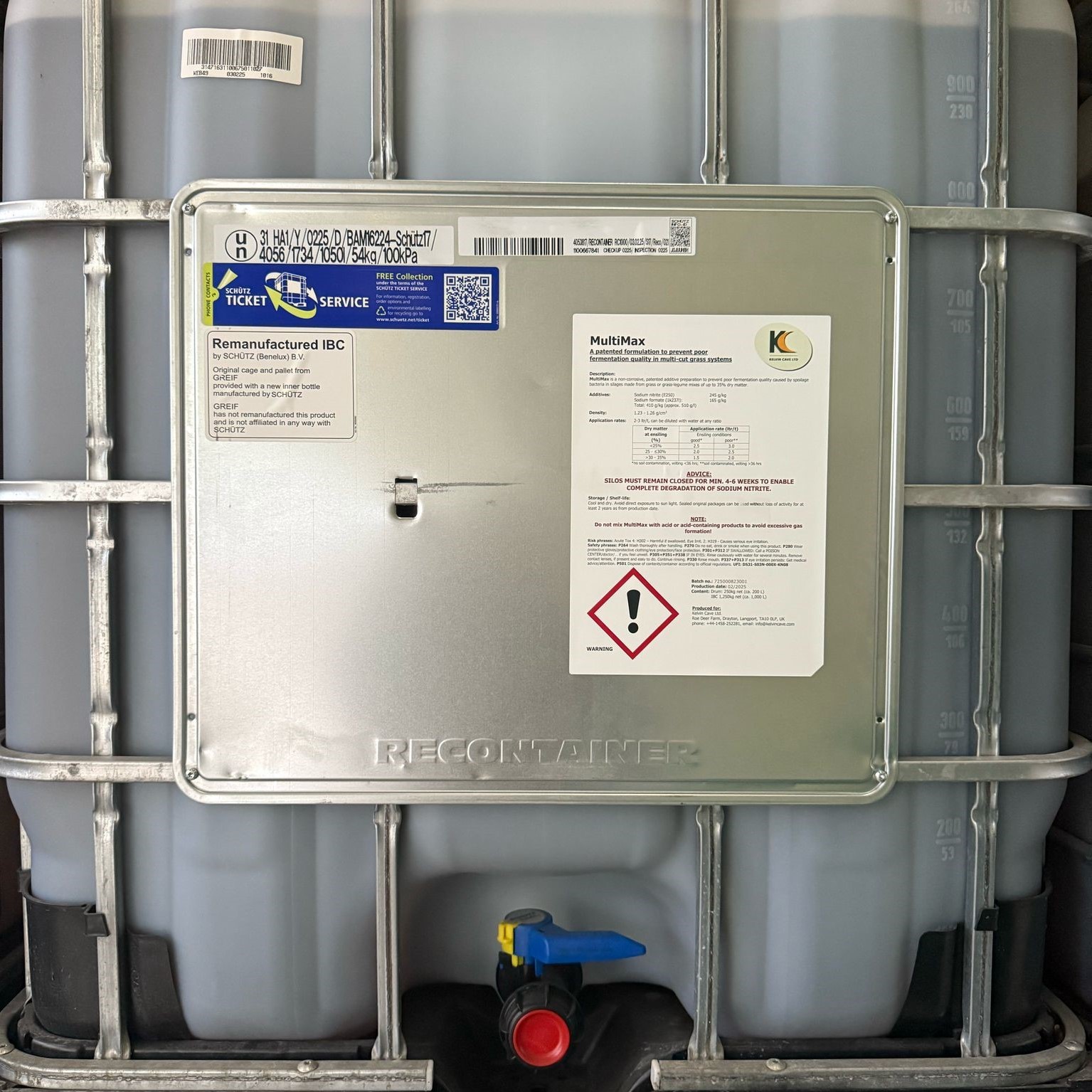
- For multi-cut grass systems
- Suitable for grass and legume silages up to 35% moisture
- Formulated to eliminate spoilage bacteria
Safesil Challenge
- For lower DM grass silage
- Human food-grade preservative
- Suitable for clamps, bales and ag-bags