Buying a bale of TMR at the click of a mouse

The practice of buying goods online has made its way into virtually every corner of modern life. But what about total mixed rations? Is it possible for a TMR to be compacted into bales and delivered on farm – even on a single pallet – at the click of a mouse?
Emphatically yes, according to Herefordshire farmer, Stephen Ware, who has devoted a lifetime of farming to innovative thinking and diversifying his enterprise, which now includes an e-commerce site through which farmers can buy bales of a compacted TMR, alongside apples, cherries, pears and crimped and wholecropped cereals.
Farming around 300 acres (121ha) at Throne Farm near Weobley, growing and making the TMR is part of a web of interwoven farming operations, many reliant on the other, and each adhering to sustainable principles on this mixed farm. As such, Stephen is rebuilding the heart of the farm on which he follows his father and grandfather, merging its historic virtues with the regenerative farming practices he’s been following since 2010.
Today, he is moving away from monocultures – whether of wheat or barley or orchards – and integrating farming practices to create a more circular business, where the risks of growing a single crop or selling to a single buyer, have been largely removed.
At the heart of this system is agroforestry, created by a combination of fruit tree plantings (20,000 in 2017) and reconfiguring large swathes of intensive cider orchards by removing most of the trees but retaining every fifth row. Between the trees, sheep may be grazed or pulses or cereals grown, either used as part of the TMR or baled as wholecrop and sold off the farm.
“We’ve been introducing diversity,” explains Stephen. “Air and light around the trees mean they’re less of a target for pests and disease, so we need fewer pesticides.”
And contrary to conventional wisdom – that tree roots reduce the nutrients available for the arable crop – he says the opposite can be true.
“In a standard arable system, the highest yields are expected in the middle of the field but in this system, the highest yields are at the edges,” he says, explaining how there’s increasing reliance on soil structure and biodiversity as inputs decline.


“When we tested in 2012, early in our regenerative journey, we had a deficit of fungi in the soil. This suggests the trading platform between the bacteria, fungi, protozoa and the crop was broken,” he says.
Setting out to rebuild the health of the soil, he also had to cut back on inputs, most notably phosphorus. This ad been built up over decades of poultry farming and spreading poultry manure – a practice now significantly reduced.
Growing ingredients for the TMR fits with all the farm’s principles, while preserving the ration to the highest possible standard is an essential part of the de-risking process and ensures buyers have confidence that every bale will be as good as the last.
Ingredients in each high-density bale – compressed in an Orkel Hi-X baler, originally used to compact chicken manure – include crimped wheat, wholecrop beans, sugar beet pellets, wheat straw and molasses, with beef finisher minerals, limestone flour and Actisaf live yeast.
Noting that the crimp is an integral part of the ration, Stephen says he values the crimping process on several levels.
“I started working with [feed and forage preservation specialists] Kelvin Cave Ltd around five years ago, having been very taken with the process of crimping,” he explains.
Particularly keen on the early harvest, he liked the fact that the crop was less mature and retained more of its nutrient value than a dry crop of cereals, but he says: “I soon worked out that an equally important benefit was the shorter growing season. “It gives us more flexibility, although it requires an open-mindedness in our contractor,” he says. “We learned a new set of principles and Kelvin Cave Ltd were very good at advising and we had Michael Carpenter [Technical Director], to guide us through the process.”
Often finding himself able to gain an extra catch crop – even for as little as eight weeks between harvesting crimp and sowing winter cereals – this helps meet his ambition of keeping his ground under vegetative cover at almost all times.
Spring beans for wholecropping as another component of the ration have the further benefit of bringing nitrogen into the soil from the natural, fixing process. The resulting total mixed ration analyses at a dry matter (DM) of 57%, protein 14.4%, starch 37.3% and metabolisable energy (ME) of 11.8MJ/kg DM. Formulated by a professional nutritionist, it is projected to achieve liveweight gains of 1.46kg/day for bulls and 1.35kg/day for steers.
Alternative rations can also be created for sheep and dairy producers.
Admitting to the need for a certain mindset amongst customers in buying a baled product for over £200 a tonne, he says: “It’s not comparable with a bale of hay or silage; it’s nutritionally matched to a compound feed – although better for the animal’s digestion – and weighs over a tonne per bale.”
A weighbridge has recently been installed for known weights to be purchased, while the high quality of product is said to be mirrored in animal health and performance, both of which are confidently predicted to benefit from the ration.
“Any ration containing a high component of quality forage is beneficial to ruminant digestion but the crimped cereals add a further dimension,” explains Michael Carpenter.
“Crimp is both safer for the rumen and more digestible than dry rolled grain. It can therefore be fed in higher quantities, without the risk to rumen health that comparable amounts of dry cereals would bring,” he says.
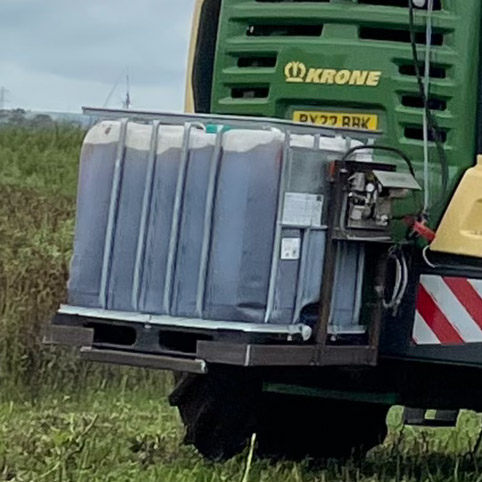
The quality of both the crimp and wholecrop beans is ensured by the choice of preservative used in their production, which reassures buyers of the keeping quality of the TMR.

Additives for both the wholecrop beans and the crimped cereals are salts-based chemical preservatives – Safesil Pro for the beans and CrimpSafe 300 for the crimp – chosen for their proven ability to remove risk from the process.
“These products work by eliminating harmful bacteria and ensuring that a favourable fermentation quickly preserves the crop with the least possible loss of nutrients,” explains Michael. “Once the bale of TMR is opened, buyers can be assured it will have excellent keeping qualities on exposure to air, allowing livestock to feed straight from the bale without the risk of heating and spoilage.”
This is assured by the ingredients contained in Safesil Pro and CrimpSafe 300, both of which include preservatives licensed for use in human food.
Compacted TMR bales for farm-to-farm trading
- Compressed by Orkel compactor baler to
average weight of 1.036 tonnes/bale - Approx price of £212/tonne, dependent on size
of order - Sold by the bale or tonne, from one bale on a
pallet to a lorry load - Include crimp, wholecrop beans, sugar beet
pellets, molasses, minerals and yeast - Analysis: DM 57%, protein 14.4%, starch 37.3%
and ME 11.8MJ/kg DM - Crimp preserved with CrimpSafe 300 and
wholecrop beans with Safesil Pro
Stephen says he finds customers for his bales are far more discerning than in the past, and increasingly understand what specification of feed they need and the value of the ration.
Buyers include a cross-section of livestock farmers, from small-scale producers who don’t have any mixing facilities of their own and may even buy a single bale on a pallet, to larger producers who may buy a load when their own feed runs low.
“A particular attraction is for small producers who can benefit from the type of TMR feeding – with all its virtues for rumen health and livestock performance – they may not have previously had at their disposal, without the equipment or maybe even the labour to create the ration,” adds Michael.
Stephen’s customers also appreciate the low food miles and carbon footprint of UK farm-grown produce, many support his regenerative approach to farming and all of them enjoy the benefits of removing the middleman by trading from farm to farm.
Request a call back
You may also be interested in

Arable farmer ditches combine in favour of forage
A Yorkshire farmer has turned a difficult situation following this summer’s drought to everyone’s advantage in a move which could be replicated across the country to help alleviate the forage crisis.
Learn more
Are you Slurry-wise?
Increasing fertiliser costs have undoubtedly focused minds on reducing input costs but, as detailed in the last issue of KnowHow, depriving a crop of grass of its required nutrients is not cost-effective, even with bagged fertiliser at almost £1,000/t.
Learn more
As input costs rise, is it time for a reset?
Rising input costs require a short, medium and long-term strategy if we are to protect and develop profitability.
Learn moreRelated products
Safesil Challenge
- For lower DM grass silage
- Human food-grade preservative
- Suitable for clamps, bales and ag-bags