
Milling mixed crops to perfect a dairy ration

Norfolk dairy producer, Stephen Temple, is not only growing beans to include in his dairy herd’s ration, but is working with scientists and agricultural engineers to improve their nutritional value.
Dairy farmer and cheesemaker, Stephen Temple, has been an innovator throughout his working life. Ever since taking his degree in agriculture at Reading University, his masters in agricultural engineering at Newcastle and his PhD at Wageningen in the Netherlands, he has engineered solutions for agriculture, from tobacco to tea.
So, after returning from 20 years teaching and researching agricultural engineering in Malawi to the family farm at Copys Green, near the north Norfolk coast, it was clear the business would be run with innovation at its heart.
Working with his late father, John, from 1998, the farm’s enterprises conformed to the traditions of that time. This included cattle reared on the Holkham Marshes, a high-input herd of Holsteins nudging 12,000 litres and an intensive arable operation.
But on John’s death in 2005, the farm contracted with the loss of lifetime tenancies, declining from 1,300 acres (526ha) to 550 acres (223ha) today. Now it comprises mostly owned land, accumulated over six generations of the Temple family, apart from the few acres of meadow, still rented from the Holkham Estate.
The reduction in acreage has led to a switch in farming ethos, as the focus has moved towards both self-sufficiency and earning more from a smaller business. This has been combined with a further shift since 2019, when intensive farming began to make way for regenerative practices as Stephen sought to farm with more environmental sensitivity, increasing biodiversity and returning fertility to the land.
By that time, the Holsteins had already made way for a herd of Brown Swiss and Stephen’s wife, Catherine, had established a farmhouse cheese-making operation. Branded Mrs Temple’s Cheese, the range includes Binham Blue, Copy’s Cloud and Walsingham, and is sold throughout the UK in farm shops, restaurants and delicatessens.
Feeding the dairy herd from ingredients grown on the farm has been a further priority, helping to improve sustainability and enhancing security and profitability for the business.
“The more we are in control of our own supplies the better we can run our business,” says Stephen, also remarking that Arla, who buy the remaining milk, apply a price penalty if soya is fed.
“The marketing of our cheese also drives us and we advertise it as a local product made with renewable energy from our own resources,” he says. “When we used to sell at farmers’ markets, we found people were really interested in animal welfare, and in the sustainability of the cows’ ration.”
To this end, the focus has moved towards home-grown protein, such as lucerne and beans, alongside the cereal crops.
“We’ve been growing winter beans to feed our cows for a few years but have recently started growing them as a mixed crop with oats, adding diversity to our cropping in line with regenerative principles,” he says.


Processing mixed crops
The single crops had been processed through a roller mill, operated from a tractor’s PTO. This worked well for the separate crops but whenbeans and oats were combined, they had to go through the mill twice.
“We had to have the rollers wide enough for the beans, and once they were rolled, we would reset the rollers for oats for the second pass,” he says. “This involved more energy, more labour and more opportunity for error, so we decided to try to find another way.”
A hammer mill was tried but quickly dismissed for creating too much dust, so the next step was to visit McArthur Agriculture, an equipment manufacturer in Scunthorpe.
“I was primarily going to investigate toasting the bean and oat mix and a sample of our toasted product was going to Belgium for testing in live cattle trials,” he says
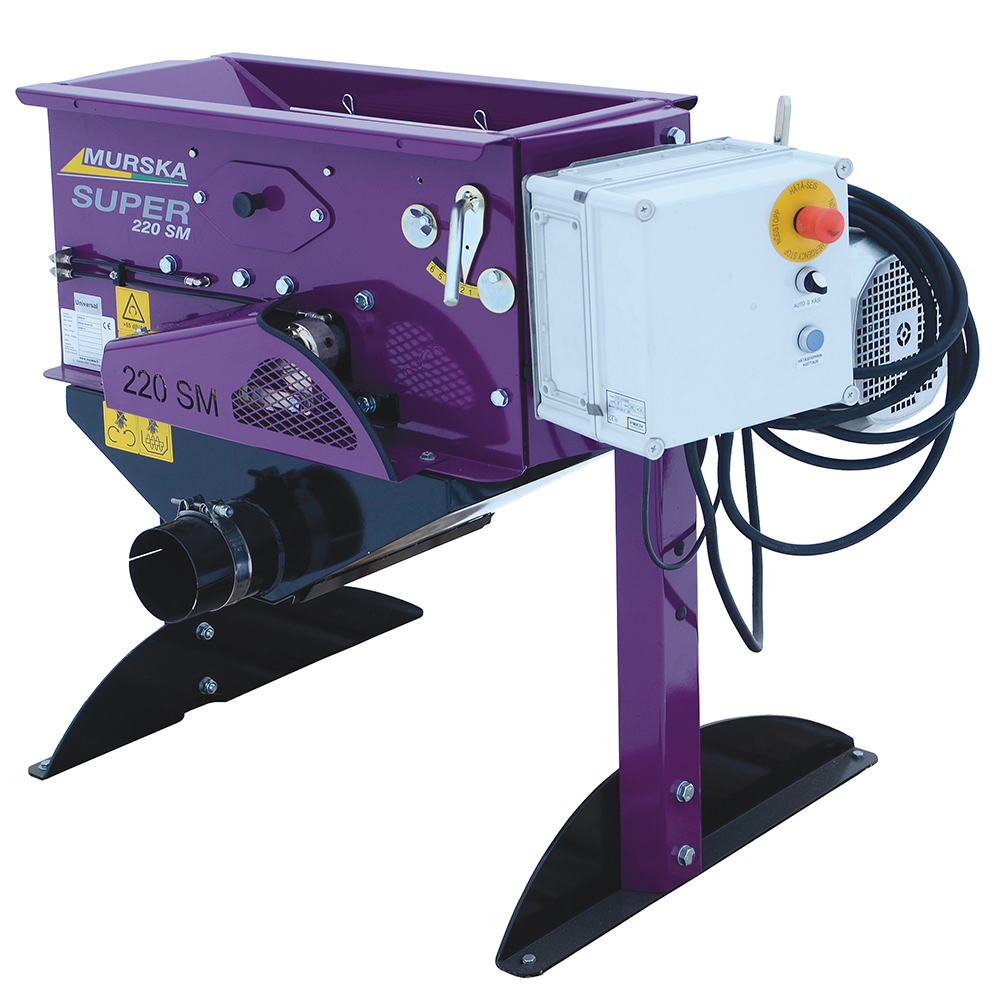
“However, while I was there, I saw a Murska 220SM with pre-crimper – a single mill with two pairs of grooved rollers, one running above the other. It was very simple and low powered, and I wondered why
I hadn’t seen one before,” he says. “It’s a nicely designed machine and is the only one I’ve seen that’s made for this job. With so many people now bi-cropping, encouraged by the Sustainable Farming Incentive [SFI], I think it could have a place on many farms.”
Describing it as ‘exactly what I needed’, he purchased the same machine from Kelvin Cave Ltd, and set it to work on the bean-oat mix. Running on electricity – a change he aims to make across the farm – he says the machine operates without any stress.
“It works very well, with low power consumption and one pair of rollers running at a quarter speed and the other at the normal rate,” he says, remarking that the farm also has plentiful electricity, generated from its own 170kW anaerobic digester.
Stephen has also fitted sensors so the mill can run without supervision, stopping either when the hopper is empty or the discharge heap is full.
“This means that if the job takes a couple of hours, there’s no need for someone to stand around waiting as the machine cuts out when it’s finished.”
Cattle performance
The Brown Swiss cattle perform well on the mix, yielding an average 8,000 litres at 4.28% fat and 3.4% protein.
Stephen’s nutritionist, Tanya Colman from Kite Consulting, says they perform exactly as they did on other protein sources which in itself is a win.
She says: “The beans have done really well and are a good protein source, but they contain anti-nutritional factors such as tannins, which can reduce the digestibility. This limits the quantity which should be fed, although we are well under that level – only including less than 1kg/head/day in the ration.
“However, it’s hard to be prescriptive on exact quantities to feed, as this depends on factors such as milk yield and complementary forage types and may be affected by how the beans are processed.”
On Copys Green Farm, rapeseed meal is also included as a protein source, fed at a rate of 1.8kg/head/day.
However, Stephen says: “If we find – through the Belgian trials – that toasting the beans and oats will improve their protein quality, allowing more to bypass the rumen, we hope to increase their inclusion in the ration.”
Beans in the crop rotation
For the crop rotation too, beans and other legumes are earning a place, helping in particular with soil quality.
“The legumes improve soil structure and biodiversity and after five years of lucerne, we grow the best cereal crops ever – you can see the benefits for years.
“We use a direct drill with tungsten carbide points – first drilling the beans and then changing the depth and separately drilling the oats,” he says.
The more we are in control of our own supplies the better we can run our business.
“For harvest, we set the concave on the combine to suit the beans and set the air so it doesn’t blow the oats back. This does mean the sample isn’t clean but that really doesn’t matter when we are feeding it all to our own stock,” he says.
No fertiliser is used, just one application of herbicide, and rarely any fungicide, and expectations were that the beans would be the last crop to harvest on the farm.
However, he says: “When you grow them with oats they seem to ripen earlier – like the fruit in the bowl with a ripe banana!
“People said this would happen but you are sceptical until you see it yourself, but we find we usually harvest in late July – a month earlier than our original expectations.”
Overall, the effects of the legumes, the bi-cropping and general regenerative practices have been profound on Copys Green Farm.
“Our costs have dropped dramatically,” says Stephen, attributing this not only to the home-grown over the purchased feed, but also to the reduction in tillage and the saving in fuel, plough parts and the back tyres of tractors.
“Our soil has also improved beyond recognition,” he adds. “It’s no longer like a brick when it’s dry, but nice and crumbly with roots running through.”
Soil organic matter is also considered to be good for the soil type – a sandy loam over chalk running through most of the farm – and hopefully rising.
“We are not sure as we should have taken a baseline for this, and for biodiversity, before we started but we just blundered in,” he says, recognising the need to measure and monitor to drive forward progress.
“I was a late starter on the farm – I didn’t become a farmer until I was 56,” he adds. “We haven’t time to stand still – we learn something new every day.”
Dairy herd summer total mixed ration (fresh weights)
For maintenance plus 22 litres
- 14kg maize silage
- 6kg lucerne silage
- 13kg grass silage
- 4.5kg premix (beans/oats, barley, rapemeal and minerals)
This ration assumes the consumption of 30kg grazed grass. A 15% protein concentrate is fed to yield in the parlour (its protein increasing to 18% in winter when the TMR is also adjusted).

Copys Green Farm Facts
- 550 acres (223ha) now including dairy, cheese-making and arable
- 130 Brown Swiss yielding 8,000 litres at 4.28% fat and 3.4% protein
- 2001: established Mrs Temple’s Cheese using milk from the herd
- Remaining milk sold to Arla
- 2009: installed anaerobic digester fed with slurry and forage
- 2019: started transition to regenerative farming practices
- Practices include strip tillage, cover crops, and minimal chemical use
- Rotation now includes beans, lucerne, cereals and cover crops (eg phacelia, vetches, mustard, radish)
Request a call back
You may also be interested in

A trailer for an epic success: SilaPactor
Kelvin Cave have developed this simple yet sturdy SilaPactor transport trailer for the growing number of farmers keen to benefit from using the SilaPactor and for the contractors who often travel many miles between farms.
Learn more
Machinery Matters
With our own comprehensive workshop facilities, we’ll show you how easy it can be to keep your grain processing machinery in peak condition, as well as replacing or upgrading to your very own requirements.
Learn more
New Murska 4000 – The worlds biggest grain crimper
Boasting an impressive output of up to 80 tonnes/hour, the latest addition to the Murska/Korte stable of crimpers delivers the performance requirements of large-scale farming operations, including contractors and animal-feed blending plants.
Learn moreRelated Products
Murska 350

- Output 5-8 t/hr
- 2mm fluted rollers process all cereal and pulses down to 45% moisture
- 3m chain and flight discharge elevator
Murska 4000

- Maximum output of 80 tonnes/hour
- 4 pairs of 1m long fluted rollers
- 5m folding belt elevator